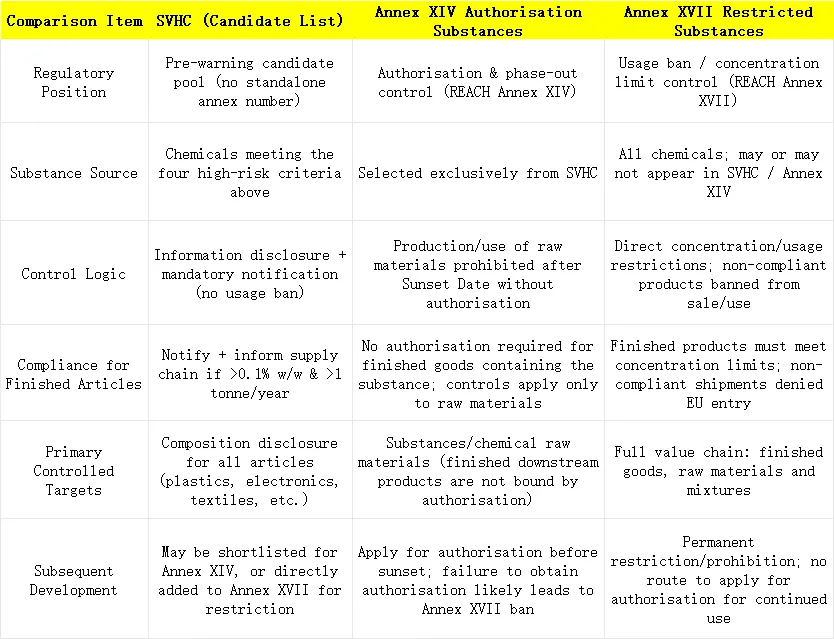
SVHC (Substances of Very High Concern), Annex XIV Authorisation Substances and Annex XVII Restricted Substances are the three core lists under REACH with a progressive hierarchy. SVHC serves as a candidate alert list; Annex XIV Authorisation Substances form an authorisation-controlled list screened from SVHC; Annex XVII is a cross-category restriction/prohibition list.
Substances posing serious and irreversible risks to human health or the environment, included in the Candidate List. It acts as the pre-qualification pool for Annex XIV authorisation substances. Four categories of substances qualify for inclusion:
· CMR 1A/1B (Carcinogenic, Mutagenic or Reprotoxic Category 1A/1B)
· PBT (Persistent, Bioaccumulative and Toxic)
· vPvB (very Persistent and very Bioaccumulative)
· Endocrine disruptors or other substances with scientifically proven equivalent high risks
Core Obligations
· If a substance is present in an article above 0.1% w/w and the total annual EU export volume exceeds 1 tonne: the enterprise shall submit SVHC notification and SCIP notification to ECHA.
· Supply chain disclosure of substance information to downstream users in accordance with REACH Article 33.
Strictly controlled substances incorporated into REACH Annex XIV after ECHA risk assessment and screening from the SVHC Candidate List, governed by a sunset phase-out regime subject to authorisation requirements.
Core Obligations
· LAD (Latest Application Date): 18 months prior to the Sunset Date. If enterprises intend to continue using the substance after the Sunset Date, they must apply for specific EU authorisation by this deadline.
· After the Sunset Date, production, import and use of the substance (as pure substance or in mixtures/raw materials) are prohibited without valid authorisation or exemption.
Note: Only SVHC substances are eligible for Annex XIV inclusion, though not all SVHC substances will be selected for Annex XIV.
Defined under the restriction regime of Title VIII of REACH, this is an EU-wide mandatory restriction/prohibition list. It regulates all substances presenting unacceptable risks to humans or the environment by directly specifying concentration limits, applicable scenarios and prohibited product categories. Controls fall into three types: ① Full ban across all articles ② Concentration limits for specific products (e.g. phthalates ≤0.1% in toys, nickel release limits for jewellery) ③ Restricted application fields (banned in daily consumer goods but exempt for industrial use)
Note: Substances on Annex XVII do not have to originate from SVHC or Annex XIV. For example, nickel, phthalates and PFAS are not listed in SVHC but regulated under Annex XVII.
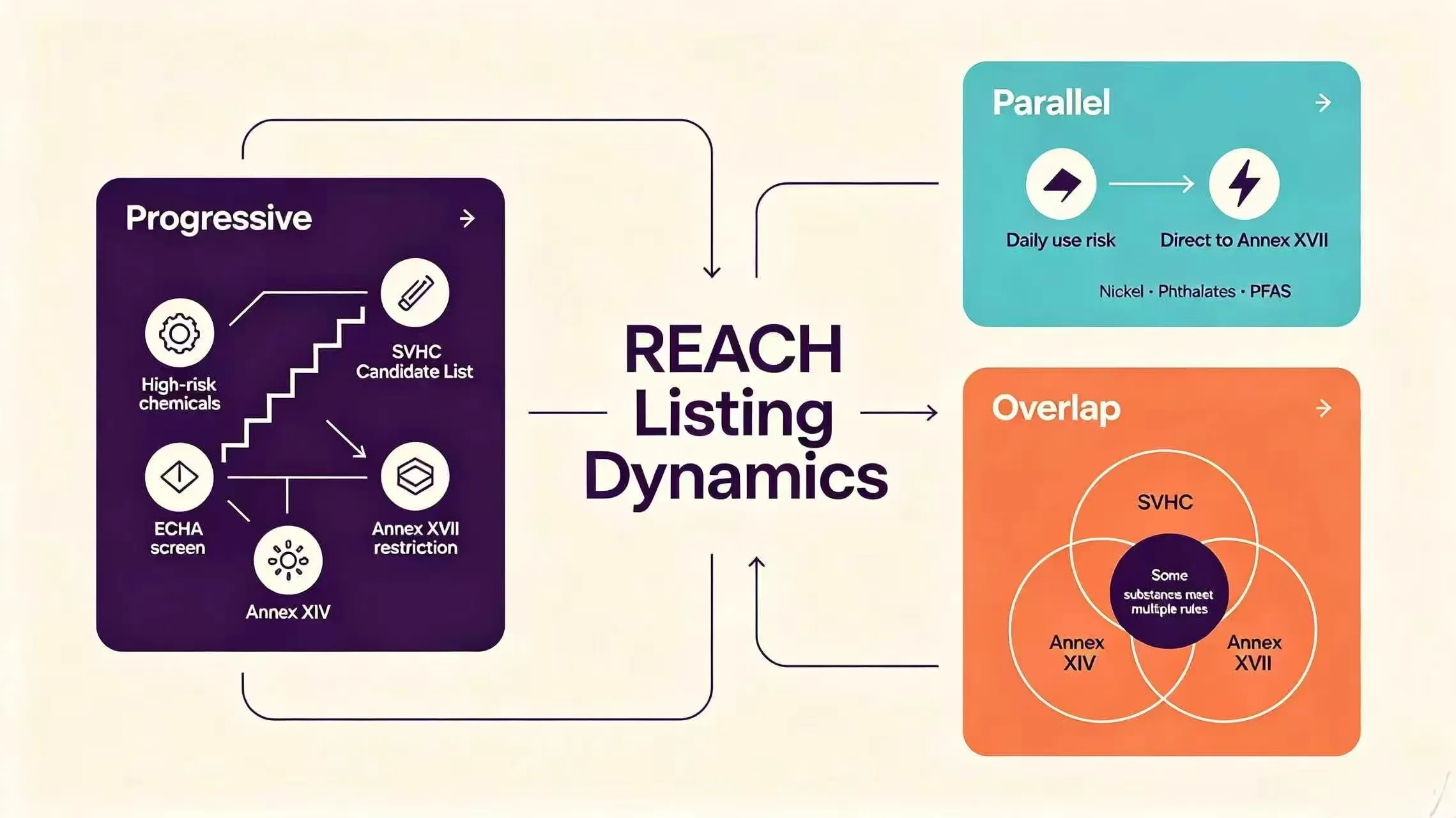
1. Progressive Relationship: Ordinary high-risk chemicals → assessed and added to SVHC Candidate List → high-priority substances screened by ECHA → included in Annex XIV Authorisation List → no authorisation obtained by sunset → legislated into Annex XVII for full restriction or ban.
2. Parallel Relationship: Many substances bypass the SVHC-to-Annex XIV route and are directly listed in Annex XVII due to exposure risks in daily use (e.g. nickel, phthalates, PFAS), never appearing on the SVHC list.
3. Overlap Relationship: Certain substances are listed in SVHC, Annex XIV and Annex XVII simultaneously (e.g. some phthalates and lead compounds), requiring compliance with all three sets of requirements.
1. SVHC: Test products for SVHC. Notify ECHA via SCIP and SVIP channels if content exceeds 0.1% w/w and annual shipments exceed 1 tonne.
2. Annex XIV: For raw materials/pure substances/liquids on Annex XIV, suppliers must hold valid EU authorisation. Finished articles containing Annex XIV substances do not require certification.
3. Annex XVII: Products must strictly comply with specified limits (e.g. lead and phthalate limits for children’s products). Non-compliant consignments will be blocked at EU borders with no exemption application available.


 English
 日本語
日本語 français
 Deutsch
 Español
 italiano
 русский
 português
 العربية
 Türkçe
 dansk
dansk