Foreign trade enterprises manufacturing food processing machinery, commercial catering equipment, pressurised food-contact vessels and metering catering appliances will inevitably encounter the UKCA conformity mark when exporting to the United Kingdom (England, Scotland, Wales).
Most industry practitioners confuse compliance boundaries between UKCA, EU FCM and CE marking: ordinary food tableware does not require UKCA, yet commercial food machinery and pressure vessels are subject to mandatory UKCA requirements. Misunderstanding this distinction frequently results in cargo detention at customs and failed tender bids.
UKCA stands for UK Conformity Assessed. Launched on 1 January 2021 post Brexit, it is the statutory market access mark for Great Britain (England, Scotland and Wales). It certifies that products meet safety regulation requirements transposed into UK domestic law.
Key distinction: Northern Ireland does not apply standalone UKCA; it follows the dual marking system of CE + UKNI. This document covers rules for Great Britain (GB) only.
Product Safety and Metrology (Amendment) Regulations 2024, effective October 2024. EU CE marking is permanently recognised for parallel use on the UK market. Enterprises may freely choose either the UKCA or CE compliance route; there is no mandatory end date for phasing out CE, significantly cutting compliance costs for foreign-trade businesses.
Products requiring mandatory UKCA (obligatory for exports to Great Britain)
· Food processing machinery (dough mixers, blenders, sterilisation equipment, filling machines, commercial food processors): governed by the Supply of Machinery (Safety) Regulations.
· Pressurised food contact vessels (carbonated drink pressure tanks, pressurised cooking appliances, foam sealed pressure vessels): regulated under pressure equipment legislation.
· Metering catering appliances (0.05 L-5 L fixed volume measuring jugs, commercial metering dispensing containers): subject to measuring instrument regulations.
· Electrically powered food equipment (ovens, fryers, cold chain food machinery): must additionally satisfy LVD Low Voltage and EMC Electromagnetic Compatibility UKCA requirements.
Products fully exempt from UKCA (only UK FCM food contact compliance required)
Non pressurised, non electric, non metering general catering articles: stainless steel drinking cups, plates, silicone kitchenware, food contact cabinet panels, food grade sealants, ceramic tableware.
Official clarification: these are ordinary consumer goods outside the UKCA scope. They may circulate on the UK market provided they comply with domestic UK food contact material safety standards.
· Identical compliance logic: risk classification, self declaration / third party assessment, retention of technical documentation, Declaration of Conformity (DoC).
· Most test standards are interoperable (BS EN standards are equivalent to EU EN harmonised standards). Test reports may be reused; only UK specific divergences need supplementary handling.
· Consistent marking rules; technical documentation must be retained for a minimum of 10 years.
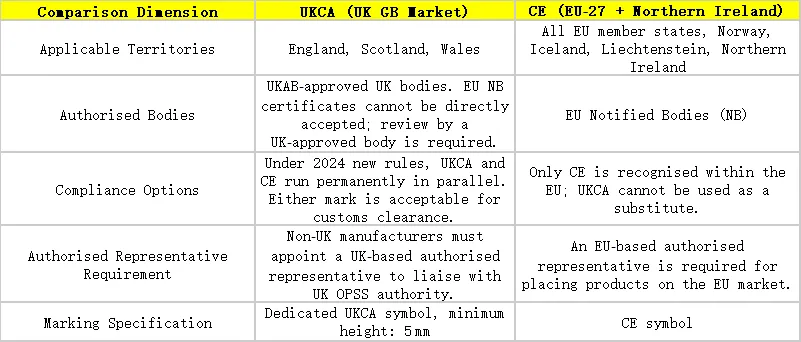
Two UKCA compliance modes exist: low-risk equipment allows manufacturer self-declaration; high-risk pressure-bearing / large-scale food machinery requires assessment and certification by a UK-approved UKAB third-party body.
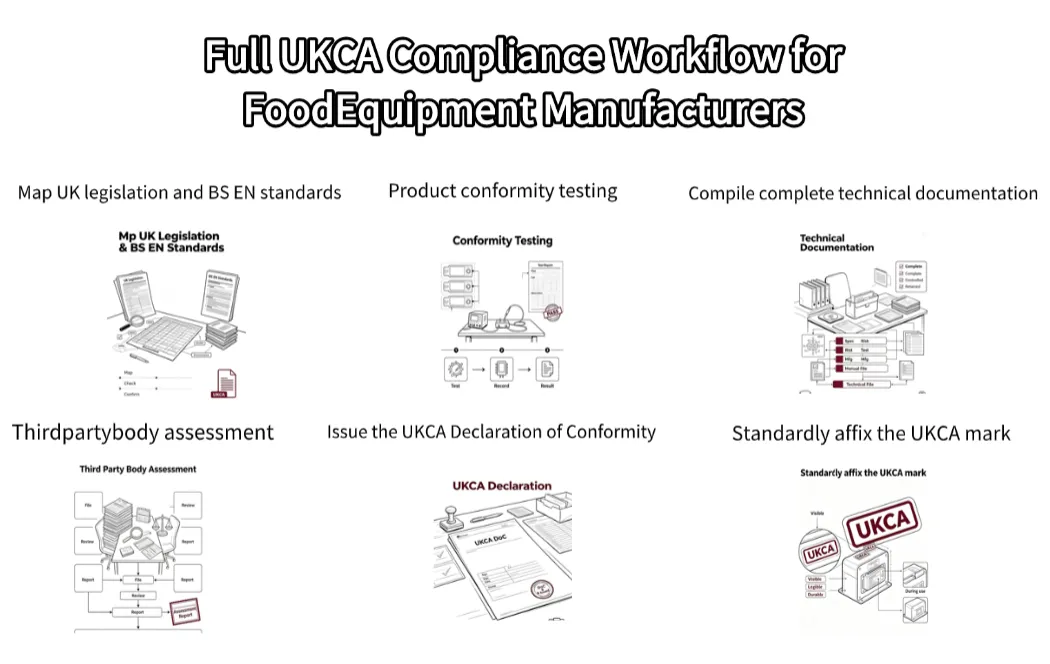
Phase 1: Map UK legislation and BS EN standards (approx. 1 week)
1. Confirm whether the product falls within the UKCA scope; identify applicable UK regulations for machinery, electrical equipment and pressure equipment.
2. Check relevant BS EN harmonised standards and identify any UK specific deviating clauses.
3. Compile two sets of compliance documentation covering product structure, electrical systems, pressure bearing components and food contact materials: UKCA safety documentation and UK FCM migration safety documentation.
Phase 2: Product conformity testing (7-20 working days)
· Where complete EU CE reports already exist: reuse test data and perform supplementary testing only for UK specific deviations.
· Where no CE reports are available: commission UK-recognised laboratories to conduct full testing for machinery safety, electrical safety, EMC and pressure-vessel performance.
· Conduct parallel UK FCM migration testing for food-contact components (regulated by the FSA, independent of UKCA).
Phase 3: Compile complete technical documentation (core inspection records) Documentation must be kept for at least 10 years and is subject to ad-hoc requests from UK market surveillance authorities. Mandatory contents: product drawings, bill-of-materials, full test reports, risk-assessment report, English-language user manual, UK-authorised-representative agreement, production GMP records, and FCM food-contact-material compliance evidence.
Phase 4: Third-party-body assessment (high-risk products only) Pressure vessels and large-scale commercial food machinery must be audited by a UKAB body to obtain a UKCA certificate. Low-risk small-scale equipment may skip this step; manufacturers retain internal test records.
Phase 5: Issue the UKCA Declaration of Conformity (DoC) — a legally binding document
The DoC must state: manufacturer details, full UK-authorised-representative address, product model numbers, applicable UK regulations, standard references, signatory responsibility and issue date. It shall be available for customs clearance.
Phase 6: Standardly affix the UKCA mark
· Minimum UKCA mark height ≥ 5 mm; mark shall be durably and legibly printed on the equipment itself.
· UKCA marking shall also appear on packaging and user manuals.
· Full name and address of the UK importer / authorised representative must be shown
Myth 1: All food-contact goods exported to the UK require UKCA. Official position: UKCA is mandatory only for food-contact products with electrical, pressure or metering functions. Ordinary plates, food-storage containers and cabinet panels only need UK FCM food-contact compliance, no UKCA marking.
Myth 2: CE marking is invalid for the UK from 2026; UKCA must be obtained separately. The October-2024 regulations permanently permit parallel acceptance of CE. Enterprises may choose either CE or UKCA for customs clearance; there is no mandatory transition deadline or CE phase-out.
Myth 3: CE certificates issued by EU-based Notified Bodies (NBs) can be directly used as UKCA certification. Partial data reuse is permitted but they are not directly equivalent. CE test reports may be shared, yet high-risk products still require review by a UKAB body, and a UK-based authorised representative is compulsory.
Myth 4: UKCA replaces UK FCM food-contact-material compliance. The two regimes are fully independent and non-substitutable:
· UKCA governs machinery, electrical and pressure safety of equipment.
· UK FCM (aligned with EU Regulation 1935/2004 framework) governs chemical-migration safety of materials. Exporters of food machinery to the UK must hold both sets of compliance documentation.
1. Statutory market access requirement for the UK Commercial food-machinery procurement by retail chains, catering supply chains and food-manufacturing tenders explicitly demands UKCA / CE compliance documentation. Missing documentation leads to cargo seizure and rejected orders. Non-compliance detected via market surveillance triggers product recalls and substantial fines.
2. Controlled compliance costs for dual-market access Thanks to interoperability between CE and UKCA test data, one set of test results can cover both EU and UK markets, avoiding full duplicate testing and lowering foreign-trade compliance expenditure.
3. Differentiated tender bid competitiveness Dual validation — UKCA safety compliance plus UK FCM food-contact-material compliance — differentiates suppliers from competitors holding only single-system certification, supporting premium positioning within catering and food-engineering channels.
4. Mitigate cross border trade dispute risks Complete UKCA technical files and DoC serve as statutory evidence for defence against consumer complaints, regulatory inspections and cross-border legal disputes in the UK, mitigating heavy recall-related losses.
UKCA is an independent safety-compliance system established post Brexit for electromechanical and pressure equipment products. It does not cover ordinary food-contact tableware; its scope is limited to commercial food processing machinery, pressurised catering appliances and metering utensils.
Under 2024 updated rules, food equipment exporters to Great Britain have two compliance options: continue using existing CE documentation for direct customs clearance, or obtain standalone UKCA certification. In either case, UK FCM food contact material migration testing is mandatory. Both compliance pillars must be satisfied.


 English
 日本語
日本語 français
 Deutsch
 Español
 italiano
 русский
 português
 العربية
 Türkçe
 dansk
dansk