For cross-border e-commerce and foreign trade merchants exporting electronic products to the United States, FCC compliance is a mandatory threshold. 90% of sellers run into compliance pitfalls because they cannot distinguish between FCC ID and FCC SDOC. These two certifications are non-interchangeable. Choosing the wrong one will result in customs detention, Amazon product delistings, and fines of tens of thousands of US dollars. This guide thoroughly covers definitions, applicable products, core differences, and application procedures in one go.
FCC stands for the Federal Communications Commission of the United States. It regulates all electrical and electronic devices sold or imported into the US. Its core objective is to limit electromagnetic interference from equipment and prevent disruptions to public communication signals such as mobile phones, radio services, and base stations. The FCC officially only recognizes two equipment authorization pathways:
FCC SDoC (Supplier’s Declaration of Conformity)
FCC ID (FCC Official Registered Certification)
The sole dividing criterion: whether the device actively emits radio frequency (RF) wireless signals.
SDoC = Supplier’s Declaration of Conformity. It is a unified system consolidated by the FCC in 2017 that replaced the old DoC and VOC frameworks. It applies exclusively to unintentional radiators: devices without Bluetooth, Wi-Fi or RF transmitting circuits. They only generate weak incidental electromagnetic noise when powered on by mainboards or chips and do not actively send out wireless signals for communication.
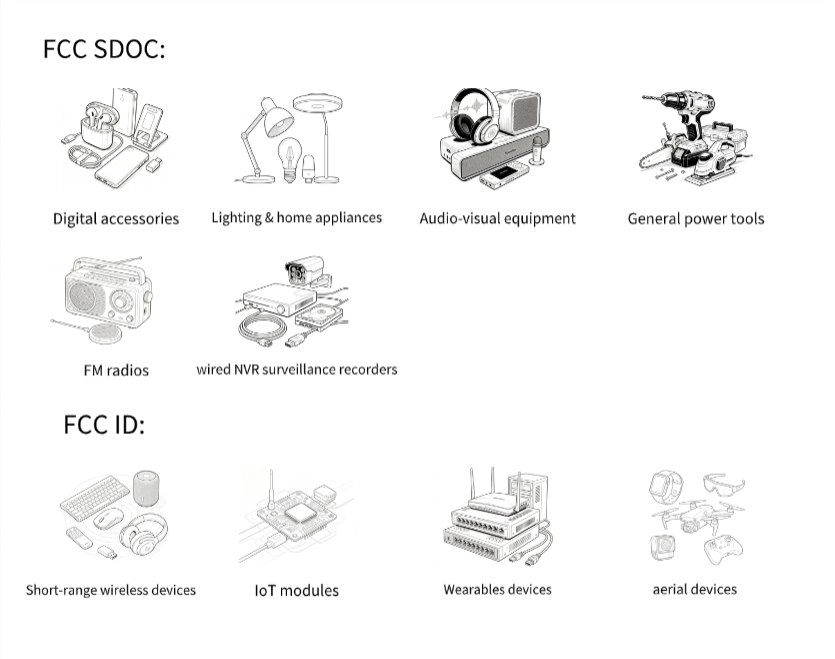
· Digital accessories: Wired keyboards/mice, monitors, power adapters, standard wired power banks, wired headsets
· Lighting & home appliances: LED tubes, desk lamps, regular floor lamps, small home appliances without wireless functions
· Audio-visual equipment: Wired speakers, desktop computers, printers, wired switches & routers
· Others: General power tools, FM radios (receive-only with no transmission), wired NVR surveillance recorders
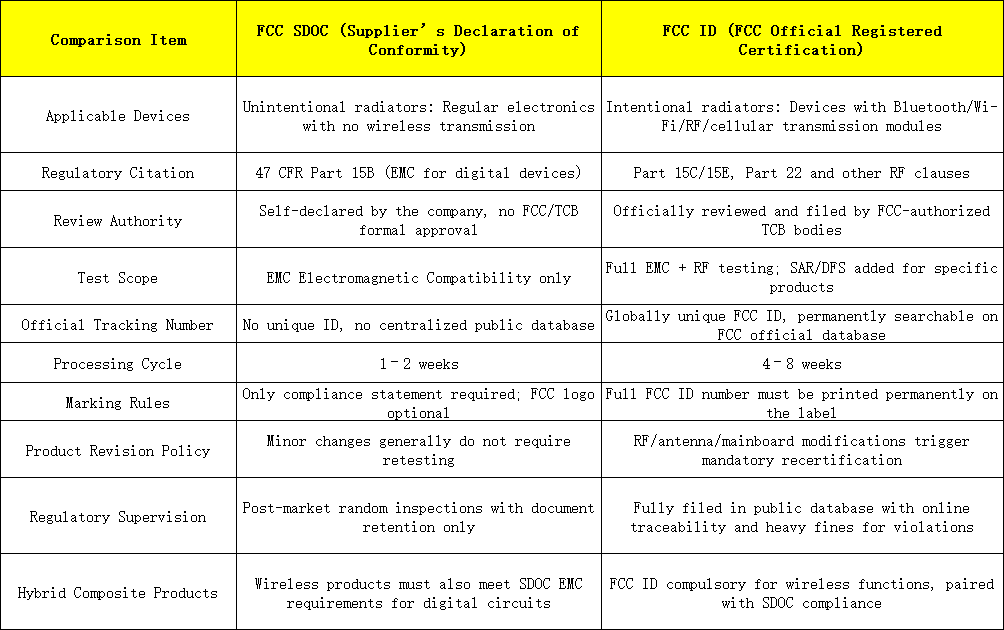
1. Test items: Only EMC (Electromagnetic Compatibility), including conducted disturbance and radiated disturbance, no RF radio frequency testing. The test verifies whether circuit stray emissions exceed regulatory limits.
2. Application Steps: ① Submit samples to an accredited laboratory for EMC testing and obtain a qualified test report. ② Have the official declaration document signed by a US-based importer or authorized agent. ③ Archive the full package including test reports, declaration forms, schematic diagrams and user manuals for a minimum of 10 years for FCC random inspections.
3. Lead Time & Cost: 1–2 weeks total processing; low testing fees with no official FCC registration charges.
4. Label Requirements: Mark the text Complies with Part 15 of the FCC Rules on the product body; the FCC logo is optional.
5. Verification Method: No centralized public FCC database for lookup. All documents are retained by the enterprise or testing lab with no retrievable public serial number.
FCC ID is a unique official identification number issued directly by the FCC under mandatory government certification. It governs intentional radiators: devices equipped with antennas and RF modules that actively transmit radio signals into the air. Critical rule: Wireless transmitting products are prohibited from using SDOC as a substitute for FCC ID, which constitutes a serious compliance violation.
All equipment with active RF transmission requires FCC ID:
· Short-range wireless devices: Bluetooth earphones, Wi-Fi routers, smart plugs, wireless doorbells, 2.4G remote-controlled toys, wireless chargers
· IoT modules: Bluetooth/BLE, Zigbee, LoRa, NFC, UWB, RFID readers/writers
· Communication hardware: Smartphones, tablets, 4G/5G modules, walkie-talkies, vehicle Bluetooth modules
· Wearables & aerial devices: Smartwatches, drones, RC model aircraft, wireless IP cameras
Key Note: Composite hybrid products (e.g., Wi-Fi-enabled refrigerators, Bluetooth-equipped power banks) must complete both FCC ID and SDOC EMC compliance.
1. Test Items: Complete EMC testing + full RF radio frequency testing (transmit power, frequency deviation, spurious emissions, bandwidth). Body-worn devices require additional SAR (Specific Absorption Rate) testing for human radiation exposure; 5G devices add DFS testing. Test scope is extensive and standards are stringent.
2. Application Steps:
① Register an FCC FRN (FCC Registration Number) for the company and apply for a permanent Grantee Code.
② Submit prototypes to an FCC-recognized accredited lab for full RF + EMC testing. ③ Compile all technical files (product photos, PCB layouts, antenna specifications, user manuals, label artwork) and submit to a TCB (Telecommunication Certification Body, FCC authorized review agency).
④ After TCB approval, the FCC assigns an exclusive FCC ID in the format: GranteeCode – Product Model Code.
⑤ Product data is uploaded to the FCC’s global public database for permanent online verification.
3. Lead Time & Cost: 4–8 weeks total. Fees cover registration, TCB review and comprehensive RF testing, resulting in higher overall costs. Recertification is mandatory if hardware, antenna or RF circuitry is modified.
4. Mandatory Label Rule: The full FCC ID number must be permanently printed on the product nameplate for cross-checking by platforms and customs against the FCC database.
5. Oversight Level: Highest priority. Amazon, US Customs and FCC investigators can verify filing records online. Severe penalties apply for counterfeit documentation.
1.Using SDOC for wireless products equals serious violation Shipping Bluetooth speakers or Wi-Fi cameras cleared solely under SDOC will lead to full container seizure by US Customs. Amazon will delist listings and suspend seller accounts upon database mismatch, with fines up to USD 10,000 per day.
2.Hybrid products require dual certification Example: Power banks with wireless charging: the wireless transmitting part needs FCC ID, while the main circuit board must satisfy SDOC EMC rules. Both sets of compliance documents are mandatory.
3.FCC IDs cannot be cross-shared across models One FCC ID corresponds to one exact product model. Recertification is required if antennas, mainboards or RF chips are altered. Borrowing FCC IDs from other SKUs counts as fraudulent compliance.
4.SDOC cannot be issued without a US Agent Chinese manufacturers alone cannot issue valid SDOC paperwork. The declaration must be signed by a US domestic importer or authorized US representative to be recognized by US Customs.
1. Only powers on for charging, display or wired data transfer, zero wireless transmission → FCC SDOC
2. Equipped with Bluetooth, Wi-Fi, 2.4G remote control, wireless charging, cellular communication or RFID transmission → Mandatory FCC ID
3. Contains both active wireless transmitters and standard digital circuitry → Dual compliance: FCC ID + SDOC EMC
FCC SDOC serves as a low-cost, fast-track compliance pass for ordinary electronic goods. FCC ID acts as the official government identity card for all wireless transmitting equipment with rigorous auditing and public database recording. The two schemes have clear boundaries and cannot replace one another. Before exporting to the United States, first confirm whether your product features RF transmission functions, apply for the correct certification and reserve sufficient lead time for processing. This avoids cargo detention, platform penalties and enables smooth market access in North America.


 English
 日本語
日本語 français
 Deutsch
 Español
 italiano
 русский
 português
 العربية
 Türkçe
 dansk
dansk