FCC stands for the Federal Communications Commission, an independent U.S. government agency established in 1934 under the Communications Act and directly accountable to the U.S. Congress.
FCC certification is a mandatory compliance certification enforced by this commission for electrical and electronic products. Its core objective is to regulate products’ electromagnetic compatibility (EMC) and radio frequency spectrum usage. It prevents electromagnetic radiation emitted during product operation from interfering with public communication networks and other electronic devices, as well as safeguards personal safety during use. Products without valid FCC certification cannot clear U.S. customs or be sold in the U.S. market, and the responsible party may face penalties such as cargo detention and fines.
Classified based on whether a product has wireless transmission functions, the two types differ significantly in applicable products, procedures and requirements.
Applicable products: All devices that actively transmit radio frequency signals Examples: mobile phones, Bluetooth earphones, Wi-Fi routers, 5G modules, wireless remote controllers, walkie-talkies, drones, vehicle-mounted Bluetooth, smart wearable devices, etc.
Key Features: Applications must be reviewed and issued by FCC-authorized TCBs (Telecommunication Certification Bodies). A unique FCC ID will be assigned to the product in the format of Grantee Code + Product Code, serving as the official "ID card" for wireless devices.
SDoC is the abbreviation for Supplier’s Declaration of Conformity. Applicable products: Ordinary electrical and electronic devices with no wireless transmitting functions but generating electromagnetic radiation during operation Examples: computers, monitors, printers, household appliances (refrigerators, microwave ovens, vacuum cleaners), LED lighting fixtures, power adapters, power tools, etc.
Key Features: No TCB review is required. Compliance is self-declared by the manufacturer or U.S. importer. Test reports must be retained for a minimum of 5 years for official random inspections.
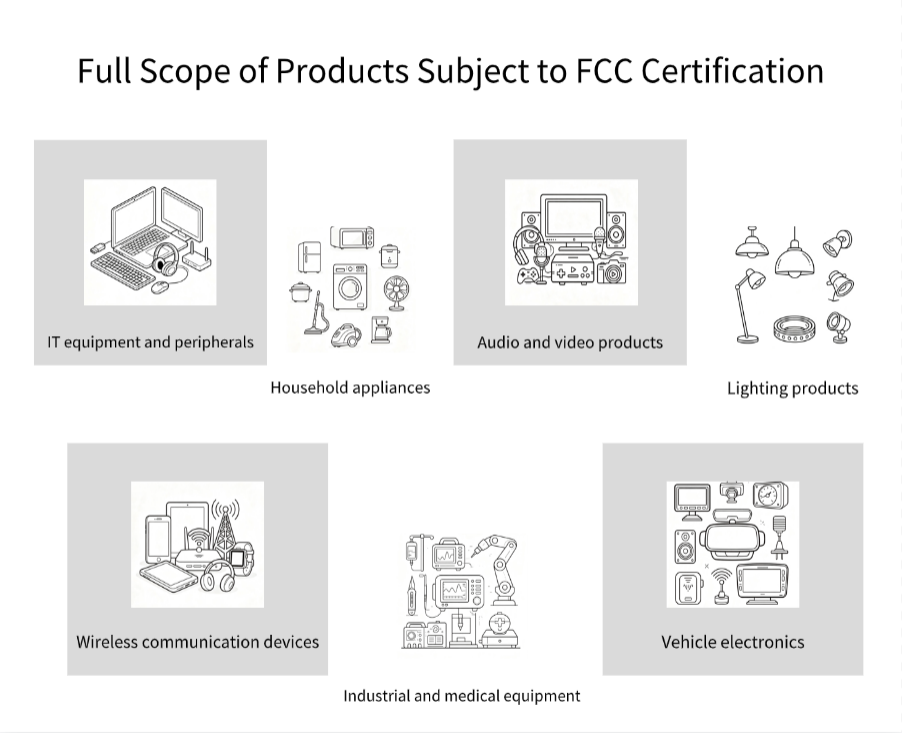
Nearly all electronic devices imported into the United States fall under FCC regulation, mainly categorized as follows:
1. IT equipment and peripherals: computers, keyboards, mice, monitors, printers, scanners, UPS power supplies, etc.
2. Household appliances: microwave ovens, air conditioners, refrigerators, hair dryers, vacuum cleaners, electric shavers, etc.
3. Audio and video products: televisions, radios, audio systems, DVD/Blu-ray players, MP3/MP4 players, set-top boxes, etc.
4. Lighting products: LED lamps, energy-saving lamps, LED display screens, stage lights, dimmers, etc.
5. Wireless communication devices: cell phones, Bluetooth/Wi-Fi devices, two-way radios, satellite terminals, remote-controlled toys, smart home devices, etc.
6. Industrial and medical equipment: industrial machinery, RF testing instruments, patient monitors, power tools, etc.
7. Vehicle electronics: car navigation systems, automotive Bluetooth, tire pressure monitoring systems (TPMS), etc.
1. Qualification Registration: Register an 11-digit FRN application number in the FCC CORES system and apply for a permanent Grantee Code (manufacturer code). Non-U.S. enterprises must appoint a U.S. agent and provide a signed authorization letter.
2. Documentation & Sample Preparation: Submit product schematic diagrams, BOM list, English user manual, label artwork, and supply 2–3 complete test samples.
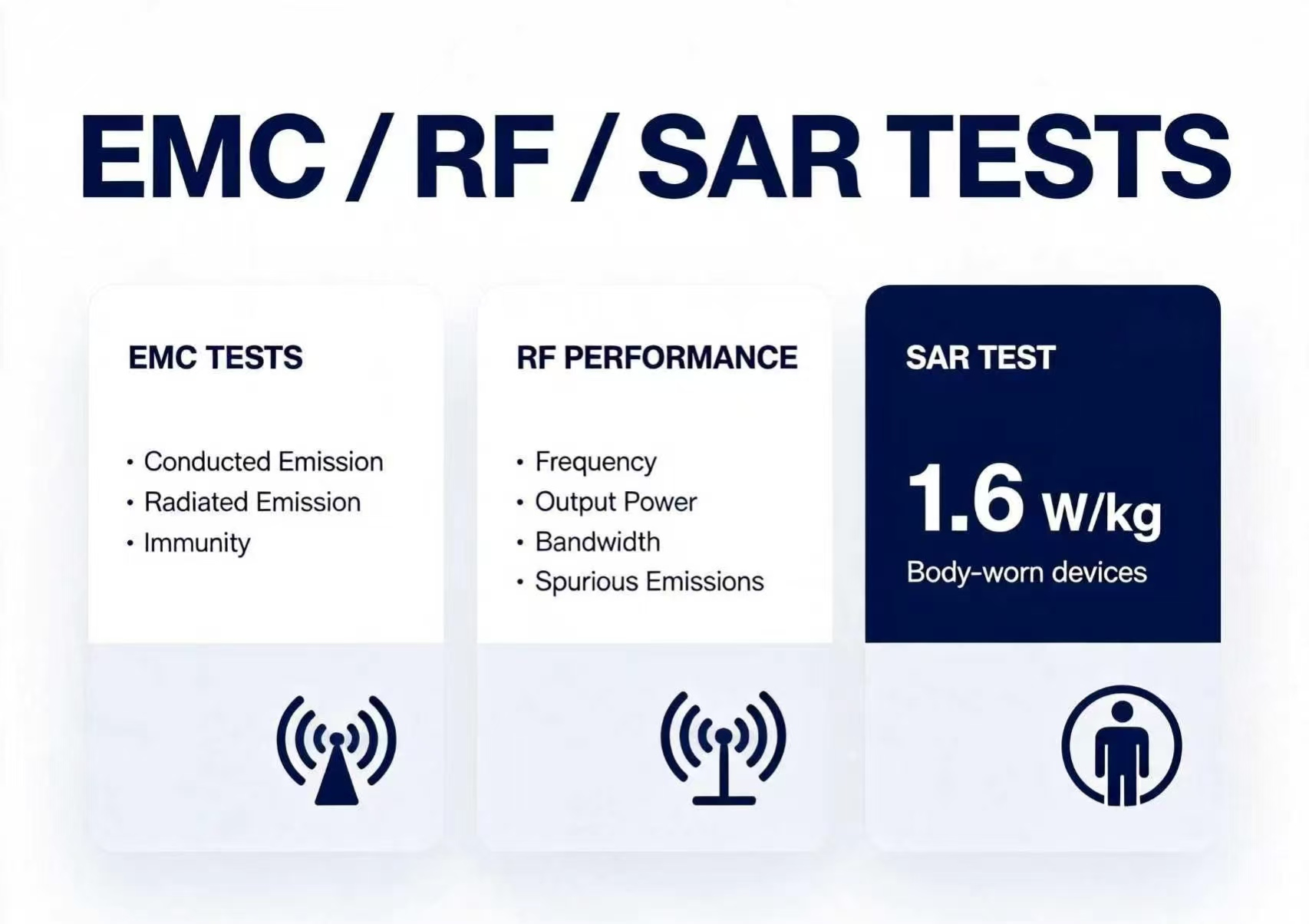
3. Laboratory Testing: Deliver samples to an FCC-recognized laboratory with A2LA/NVLAP accreditation to complete RF performance, EMC and SAR testing (for body-worn devices). Testing takes 1–4 weeks.
4. TCB Review & Certificate Issuance: Submit test reports and application forms via a TCB. An FCC ID certificate will be granted upon successful review.
5. Product Marking: Print the FCC ID number and compliance statements on the product body and outer packaging.
1. Standard Confirmation: Confirm applicable FCC rules (e.g., Part 15B, Part 18).
2. Sample Testing: Send samples to an accredited lab for EMC testing (conducted & radiated emissions), with test reports issued in 3–5 working days.
3. Self-Declaration: The manufacturer signs the Declaration of Conformity (DoC).
4. Document Archiving: Archive test reports, declaration forms and other technical files for at least 5 years.
5. Market Launch: Affix the required compliance marking on products for U.S. market distribution.
· Conducted Emission: Measure interference voltage on power cords and signal cables.
· Radiated Emission: Quantify electromagnetic energy radiated into open space by the product.
· Immunity Test: Verify the product can operate normally without malfunction under external electromagnetic interference.
Verify compliance of transmission frequency, output power, bandwidth and spurious emissions. Additional frequency band compatibility tests apply to 5G, Wi-Fi 6E and similar high-end devices.
Mandatory for body-worn wireless devices such as smartphones and Bluetooth headsets. It measures the rate at which RF energy is absorbed by the human body. The U.S. regulatory limit is 1.6 W/kg.
1. Mandatory Market Access: A U.S. federal legal requirement; uncertified goods are blocked from customs clearance and sales.
2. Mitigate Compliance Risks: Prevent cargo seizure, financial penalties and sales bans, and protect brand reputation.
3. Improve Product Quality: EMC and RF testing optimize product stability and safety performance.
4. Strengthen Market Competitiveness: Valid certification serves as credible quality proof to build trust with American buyers.
In short, FCC certification is the statutory "entry pass" for electrical and electronic products entering the U.S. market. For cross-border e-commerce sellers and foreign trade enterprises, it is critical to clarify the certification type, procedures and regulatory requirements in advance and engage qualified accredited laboratories for testing and certification. This ensures smooth market access in the United States and avoids unnecessary compliance losses.


 English
 日本語
日本語 français
 Deutsch
 Español
 italiano
 русский
 português
 العربية
 Türkçe
 dansk
dansk