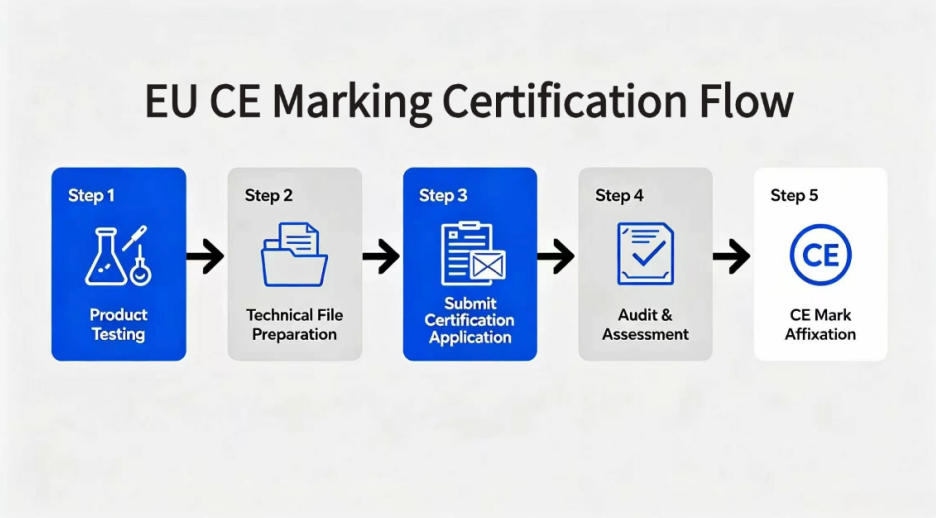
CE marking is a mandatory “market passport” for industrial goods entering the EU market.Compliance requires adherence to EU Directives and harmonised standards,compilation of technical documentation,completion of required testing,issuance of a Declaration of Conformity (DoC) and proper CE marking affixation.Non-EU manufacturers are legally obliged to appoint an EU Authorised Representative (EC REP),who acts as the EU-based legal custodian for regulatory compliance.
· CE Mark: A manufacturer’s legal declaration of compliance rather than a quality or origin label;mandatory marking for eligible products.
· https://www.huak-cer.com/certifications/ce-certification-services/
· EU Directives: Binding EU legal requirements governing product safety (e.g. Machinery Directive 2006/42/EC,Low Voltage Directive (LVD) 2014/35/EU).
· Harmonised EN Standards: Technical implementation specifications aligned with relevant Directives (e.g. EN 60335 for electrical safety, EN ISO 12100 for machinery risk assessment).
· Notified Body (NB):EU-authorised certification bodies for high-risk products, verifiable on the official NANDO database.
· Technical Construction File (TCF):Full compliance evidence dossier,which must be retained for a minimum of 10 years post product launch.
· Declaration of Conformity (DoC):Legally binding document signed by the manufacturer or EC REP confirming full regulatory compliance.
Procedure | Action | Official Reference & Tools |
Product Classification | Categorise items by function, construction and inherent risk (electrical, mechanical, construction material etc.) | Official EU Directive texts, NANDO Database |
Directive Matching | Identify all binding Directives applicable to the finished product (e.g. radio-enabled products fall under LVD + EMC + RED 2014/53/EU) | Access2Markets Portal, Official Journal of the EU (OJEU) |
Harmonised Standard Confirmation | Confirm latest valid EN harmonised standards | CEN / CENELEC Standard Database |
Risk Classification | Determine if NB certification is mandatory per Directive annex clauses (High Risk = NB compulsory; Low Risk = Self-declaration permitted) | Annex IV (Machinery), Annex IX (Electrical Equipment) |
· EU Authorised Representative (EC REP):Compulsory for all non-EU manufacturers; responsible for regulatory liaison and statutory document storage within EU territory.
· Testing Laboratory:ISO 17025-accredited labs for low-risk goods;NB-affiliated test facilities required for high-risk items.
· Technical Documentation Assets:CAD drawings,full BOM,risk assessment templates (FMEA / HAZOP).
· Role allocation: Technical Engineer (product design expertise),Regulatory Specialist (Directive research),QA/Sourcing Officer (lab & supplier coordination), designated EC REP (for non-EU manufacturers).
· Core deliverables:Finalise unified product naming & model codes,confirm target EU sales territories and lock down applicable Directives.
Standard TCF checklist for general industrial products:
1. Product master data:Product name,unique model codes,serial numbering rules, product specifications.
2. Design & manufacturing records:CAD schematics,circuit diagrams,full BOM (critical components to include respective CE/VDE/UL certificates),production process documents.
3. Formal Risk Assessment Report:Prepared per EN ISO 12100 (machinery) / EN ISO 14971 (medical devices), covering hazard identification,implemented risk reduction measures and residual risk justification.
4. Official Test Reports issued by accredited labs,covering all applicable Directives (LVD, EMC, Machinery Safety, RoHS etc.).
5. Multilingual User Manual & Product Labelling:Drafted in required EU official languages (English/German/French etc.) with mandatory safety warnings, designated CE marking position and EC REP contact details.
6. Draft Declaration of Conformity (DoC):Includes manufacturer & EC REP particulars, unique product traceability codes,full list of applicable Directives & harmonised standards,signatory name and job title.
7. Internal compliance procedure documents:In-house QC protocols, non-conforming product control records.
Newbie Tip:All documents to be compiled in English or relevant EU official languages with consistent revision control;discard superseded obsolete standards.
1. Sample submission: Prepare 3–5 production-grade test samples alongside formal test application form with specified test standards.
2. Common industrial test scope (EMC radiated emission is the most frequent failure item; pre-emptive design via shielding components or magnetic materials is recommended):
Electrical Safety (LVD): Dielectric withstand, insulation resistance, earthing compliance to EN 60204 / EN 60335
EMC Electromagnetic Compatibility: Radiated & immunity testing to EN 55011 / EN 55032
Machinery Safety (MD): Emergency stop function, mechanical guarding, noise testing per EN ISO 12100 / EN 292
Restricted Substances (RoHS 2.0):Hazardous substance limit compliance under 2011/65/EU
Radio Products (RED):RF spectrum & radio parameter testing per EN 300 440
3. Remediation workflow: Lab issues non-conformity report → engineering design modification → re-test → final approved test report issuance.
Product Risk Level | Compliance Module Route | Core Requirements |
Low Risk (standard industrial lamps, basic control cabinets) | Self-Declaration (Module A) | Complete TCF + full test data + signed DoC; No NB involvement needed |
Medium / High Risk (industrial robots, high-voltage equipment, construction products) | NB Certification (Module B+D/F) | Full TCF review + sample testing + NB-issued CE certificate with unique NB identification number |
· NB Validation: Cross-check NB’s authorised certification scope via the NANDO database using NB ID number or institute name (in-depth database guidance available separately).
· Application submission pack:Full TCF dossier,test reports,official application form, payment receipt.
· Low-risk products: Skip third-party audit, proceed directly to DoC execution.
· High-risk products: NB technical file review (1–2 weeks) → optional factory site audit (approx. 1 week) → formal CE certificate release printed with relevant NB number (valid typically 5 years).
· Certificate verification: Double-check product model range, referenced Directives & standard editions, validity term.
1. DoC Execution: Signed and sealed by authorised signatory of manufacturer or EC REP with below mandatory information:
Unique product traceability identifier (model / serial number)
Full legal name, registered address and contact info of manufacturer and appointed EC REP
Complete list of binding Directives and harmonised standards
Signatory’s official position and execution date plus company stamp
2. CE Mark Specification Rules:
Equal-height CE logo, minimum 5mm in height(proportionate reduction permitted only for miniaturised products)
Permanent indelible marking(laser engraving / printed nameplate;adhesive stickers prohibited)
Clearly visible on finished product,outer packaging or user handbook
High-risk certified goods to print relevant NB ID alongside CE (e.g. CE 0123)
1. Customs clearance: Provide customs agents with TCF extracts,signed DoC,lab test reports and NB CE certificates (for high-risk goods).
2. Continuous compliance obligations:
Archive full TCF for 10 years (stored within EU territory by appointed EC REP for non-EU manufacturers)
Track annual updates to EU Directives and harmonised standards (e.g. transitional timeline for revised Machinery Directive 2023/1230) and update documentation accordingly
Cooperate with EU market surveillance inspections by retaining full production and test archives
Reassess compliance status for any product design revision or component upgrade
1. Pitfall 1:Purchase counterfeit CE certificates → Consequence: EU customs detention, financial penalties, mandatory product recall and potential legal prosecution Solution: Only engage NANDO-listed legitimate Notified Bodies;reject unqualified uncertified intermediaries.
2. Pitfall 2:Incomplete technical documentation → Consequence:NB audit rejection or customs hold-up Solution:Build TCF item by item per checklist,secure full certification for all critical components and align BOM with actual finished goods.
3. Pitfall 3:Incorrect non-compliant CE marking → Consequence:EU market withdrawal Solution: Strictly follow size,placement and permanency marking regulations.
4. Pitfall 4: Omit mandatory EC REP appointment → Consequence: No legal EU regulatory contact & invalid document storage arrangement Solution: Contract formal EC REP prior to certification commencement for non-EU enterprises.
5. Pitfall 5:Use outdated withdrawn EN standards → Consequence: Full non-compliance ruling Solution: Always implement the latest currently enforceable harmonised standards and monitor regular standard revisions.
Stage | Lead Time | Approximate Cost (CNY) |
Directive Screening + TCF Drafting | 7–15 days | CNY 5,000 – 20,000 (in-house preparation) |
Laboratory Testing | 5–20 days | Low-risk: CNY 3,000 – 10,000; High-risk: CNY 10,000 – 50,000 |
NB Audit & Certification Issuance (High Risk Only) | 1–4 weeks | CNY 10,000 – 100,000 (variable per product complexity) |
Full Total Cycle | Low-risk: 2–4 weeks; High-risk: 1–3 months | Low-risk total: CNY 5,000 – 20,000; High-risk total: CNY 20,000 – 150,000 |
1. Directive Lookup: Access2Markets: https://ec.europa.eu/growth/tools/access2markets
2. NB Enquiry: NANDO Database:
https://ec.europa.eu/growth/tools-databases/nando
3. Official EU DoC Templates (23 EU languages): https://ec.europa.eu/growth/single-market/ce-marking_en
4. Generic EN ISO 12100 Risk Assessment Template (available via CEN official portal download)
· Day 1: Finalise product classification; confirm applicable Directives & risk tier via Access2Markets
· Day 2–3:Formal EC REP contract signing and select qualified ISO17025 test laboratory
· Day 4–10:Draft complete TCF package and validate latest applicable standard versions
· Day 11–20:Product sample testing plus rectification of all identified non-conformities
· Day 21–25:Execute legal DoC and complete standardised CE marking implementation
· Day 26–30: Collate full customs documentation, arrange EU shipment and establish internal long-term compliance filing system
CE certification core principle:Valid documentation,successful test compliance and regulated CE marking.New entrants can smoothly access the EU market by splitting compliance workstream,prioritising TCF compilation and formal EC REP appointment.
HUAK Testing Certification Service Advantages
HUAK Testing( covers an area of over 4,000 square meters, including EMC, RF, 5G NR/6G (RF), Safety, Physical, Battery, and Chemical testing laboratories. It supports a wide range of products—from consumer goods like mobile phones, computers, toys, apparel, footwear, and cosmetics, to industrial control equipment and smart home devices—helping clients meet global market access requirements. The company is equipped with internationally advanced professional testing equipment and has assembled an elite team of senior industry experts and technical professionals. Team members, with their solid professional knowledge and rich practical experience, are able to accurately interpret various complex standards and technical requirements. As a well-known third-party testing laboratory in China, HUAK has been recognized by many international organizations, including the China National Accreditation Service(CNAS) for Conformity Assessment and the US A2LA. HUAK Testing is also the designated testing and certification service provider for Amazon, and maintains close cooperation with internationally renowned notified bodies such as MICOM, element, MET, and Germany's PHOENIXTESTLAB GmbH.


 English
 日本語
日本語 français
 Deutsch
 Español
 italiano
 русский
 português
 العربية
 Türkçe
 dansk
dansk