Cross-border sellers targeting the U.S.market have almost certainly run into compliance troubles:sudden product delistings,store audit freezes, customs cargo detentions,and mass customer returns.Nine out of ten such issues stem from confusion between CPSC,CPC and GCC.
The industry is rife with misleading claims:“Get a CPSC certification to pass all checks”,“Upload test reports in place of a CPC certificate”, or “All non-children’s goods require a GCC”.These misconceptions either lead sellers to waste money on unnecessary tests and certifications, or trigger platform and customs penalties due to incomplete compliance, resulting in avoidable losses.
The biggest misunderstanding among sellers is treating CPSC as a certifiable document.
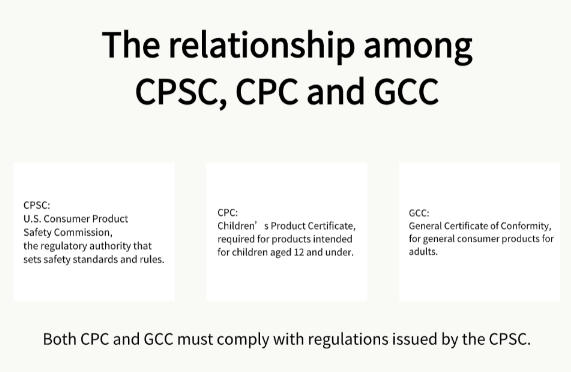
Core definition:The CPSC(U.S.Consumer Product Safety Commission) is an official U.S. regulatory authority,not a certification credential or test report.Its three core mandates are:setting national consumer product safety standards,overseeing market compliance enforcement,and penalizing non-compliant defective goods.It governs all civilian consumer products entering the U.S.market and acts as the top governing body of U.S. product safety regulations.
The CPSC does not issue certificates,conduct testing,or generate test reports.When people say a product is “CPSC-compliant”,it means the item meets safety standards established by the CPSC,has passed required compliance testing and certification filing,and satisfies official regulatory requirements — there is no such thing as a standalone “CPSC certificate”.Both CPC and GCC compliance frameworks are fully regulated and rule-set by the CPSC.
CPC stands for Children’s Product Certificate,the dedicated compliance document for goods designed and sold for children aged 12 and under.It is a mandatory document for Amazon and other e-commerce platforms,as well as U.S.customs inspections.
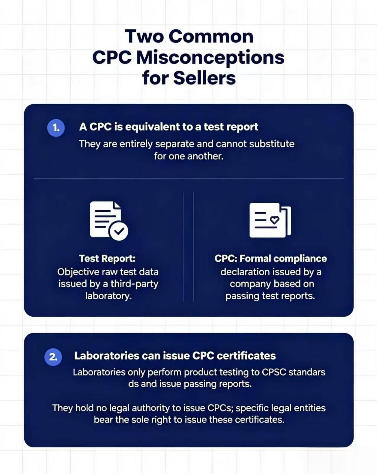
A CPC is equivalent to a test report They are entirely separate and cannot substitute for one another.A test report is objective raw test data issued by a third-party laboratory.A CPC is a formal compliance declaration issued by a company based on passing test reports.Test reports form the foundational evidence,while the CPC serves as the official proof of compliance — both are mandatory.
Laboratories can issue CPC certificates Laboratories only perform product testing to CPSC standards and issue passing reports.They hold no legal authority to issue CPCs;specific legal entities bear the sole right to issue these certificates.
1.Imported goods sold in the U.S.:Issued by the U.S.-based importer
2.U.S.-manufactured goods:Issued by the domestic manufacturer
Never reuse CPCs issued by overseas factories for imported children’s products U.S.importers must fully verify matching product models,batches and test standards before reissuing a valid CPC — this is critical to avoiding audit failures and cargo detention.
GCC stands for General Certificate of Conformity,the compliance declaration document for regular adult consumer products under CPSC oversight.
Not all non-children’s goods need a GCC.Mandating GCCs for every adult product only inflates unnecessary testing and certification costs.The clear rule:a GCC is only required for general consumer products subject to CPSC mandatory safety standards and regulations.Goods without enforced testing rules do not need a GCC.
· CPC (children’s products):Mandatory full testing via a CPSC-recognized third-party lab with strict standardized protocols
· GCC (general products):No mandatory designated laboratory requirement; compliance can be proven through full unit testing or periodic sampling, with lower compliance barriers and greater flexibility
This is the most vital rule for all U.S.cross-border sellers and determines liability during safety incidents:Whether CPC or GCC,the issuing and legally responsible party is the business entity,not testing labs or compliance consultants.
· Imported goods: U.S. importer = primary liable party & certificate issuer
· Domestic U.S. goods: U.S. manufacturer = primary liable party & certificate issuer
Laboratories only provide testing services and data reports;compliance consultants merely assist with document sorting,standard review and certificate drafting.If mismatches appear between certificates,test reports and physical products during platform spot checks,customs inspections or product safety complaints,all compliance risks and legal repercussions fall solely on the certificate-issuing business,with no recourse to testing labs.
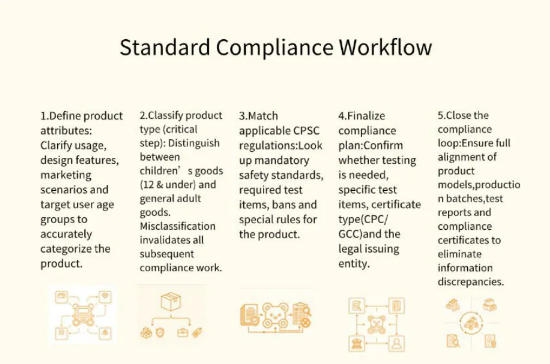
Most compliance failures stem from reversed workflows:rushing testing and certification first before matching applicable standards,leading to mismatched models,incorrect standard references and invalid certificates.
1. Define product attributes: Clarify usage, design features, marketing scenarios and target user age groups to accurately categorize the product.
2. Classify product type (critical step): Distinguish between children’s goods (12 & under) and general adult goods. Misclassification invalidates all subsequent compliance work.
3. Match applicable CPSC regulations:Look up mandatory safety standards, required test items, bans and special rules for the product.
4. Finalize compliance plan:Confirm whether testing is needed, specific test items, certificate type(CPC/GCC)and the legal issuing entity.
5. Close the compliance loop:Ensure full alignment of product models,production batches,test reports and compliance certificates to eliminate information discrepancies.
Sellers with large SKU inventories are advised to build dedicated product compliance files and standardized SKU compliance ledgers to avoid mass non-compliance issues and repeated mistakes.Key ledger records include: ✅ Full product name,model and physical specifications
✅Target user age range
✅Product classification(children’s/general adult product)
✅Applicable CPSC safety standards and testing specifications
✅ Test items,test report numbers and validity periods
✅Required certificate type and responsible issuing entity
✅ Storage links and update logs for all reports and certificates
Accurate classification and complete ledger records nearly eliminate compliance issues during listing reviews,platform spot checks and customs clearance.
1. CPSC: U.S. consumer product safety regulator;sets rules,conducts inspections and penalizes violations.It does not issue certificates or perform testing.
2. CPC: Exclusive certificate for children’s goods for ages 12 and under;requires testing from a CPSC-accredited lab and is issued by U.S. importers or manufacturers.
3. GCC: Compliance certificate for general adult products;only mandatory for items covered by CPSC enforceable standards,with no required third-party lab testing.
4. Test reports are core supporting evidence for certificates;both documents are essential and cannot replace each other.
5. Core U.S. compliance logic: First classify product attributes, match regulatory rules, then complete testing and certification.


 English
 日本語
日本語 français
 Deutsch
 Español
 italiano
 русский
 português
 العربية
 Türkçe
 dansk
dansk