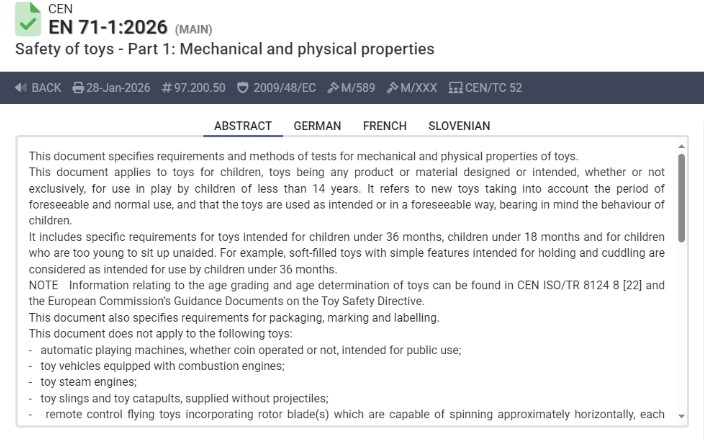
On 28 January 2026, the European Committee for Standardization (CEN) officially issued EN 71-1:2026 Safety of Toys – Part 1: Mechanical and Physical Properties. It fully replaces the long-used EN 71-1:2014+A1:2018 and serves as the core harmonized standard under EU Toy Safety Directive 2009/48/EC, setting the market access threshold for all toys intended for children under 14 sold in the EU.
This revision tightens test methods,structural strength and choking prevention requirements across six high-risk categories: food-simulating toys, ride-on toys,expandable material toys,small parts,warning markings and enclosed play equipment.Toy manufacturers and export traders are advised to seize the transition window to conduct product risk assessments, structural optimizations and pre-compliance testing,avoiding customs detention,product recalls and order losses once mandatory enforcement takes effect in 2027.
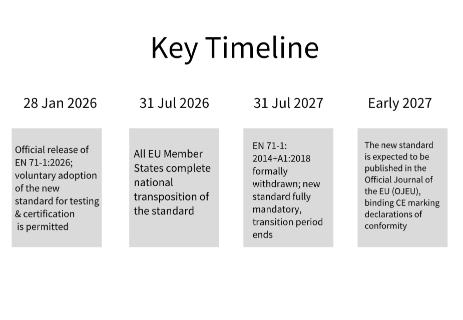
· 28 Jan 2026: Official release of EN 71-1:2026; voluntary adoption of the new standard for testing & certification is permitted
· 31 Jul 2026: All EU Member States complete national transposition of the standard
· 31 Jul 2027: EN 71-1:2014+A1:2018 formally withdrawn; new standard fully mandatory, transition period ends
· Early 2027: The new standard is expected to be published in the Official Journal of the EU (OJEU), binding CE marking declarations of conformity
Note: Both old and new standards are acceptable during the transition period. After 31 July 2027, customs authorities and test labs will conduct full audits against the 2026 version; non-compliant goods will be banned from the EU market.
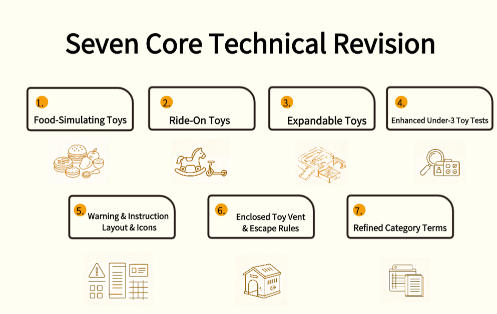
The flagship update covers highly realistic cake, candy, mini grocery and dessert toys, with clear judgment criteria defined in supporting technical guide CEN/TR 18240. Requirements: Toys and detachable components easily mistaken for real food shall not be classified as small parts and must pass dedicated choking hazard tests. Food-simulating toys for children under 36 months face stricter dimensional and pull strength rules to eliminate swallowing risks.
Expanded scope: balance bikes, single/multi-track ride-ons, wheel-less bouncing toys (pogo sticks, sleds, etc.) New mandatory product-specific tests:
· Scooters: anti-pinch gap, handlebar impact and torque locking strength tests
· Toy bicycles: brake performance, stable wheelbase, frame structural strength and minimum seat post insertion depth marking
· All load-bearing ride-ons: upgraded dynamic stability, static load and bracket fracture resistance tests; protective gear warning symbols become compulsory
For expandable toys (crystal slime, water-absorbent expanding beads), a 20 mm standard gauge test is introduced to address airway blockage risks after accidental ingestion. Fully expanded materials must pass through the gauge, referencing ASTM F963 logic to cap maximum expansion volume and reduce choking & digestive tract obstruction hazards. Tear tensile strength requirements for soft expandable fillings are also raised.
· Updated exemptions: play sand for sand pits is no longer regulated as small parts
· Inflatable toys: must pass small part and sharp edge tests under both fully inflated and fully deflated states
· Paper & glued wooden components: intensified drop and pull abuse tests to prevent fragmentation into hazardous tiny pieces
· Age warnings: the word “WARNING” must be placed above or before safety icons for priority visibility
· Ride-on & skate toys: mandatory dedicated protective gear symbols
· Load-bearing toys: unified maintenance guidelines and maximum load warnings; missing markings result in automatic non-compliance
For play tents, storage chests and head-covering toys: revised ventilation opening dimensions and multi-opening ventilation test methods, plus new child entrapment escape force tests to eliminate suffocation risks in sealed spaces. Yo-yo cord breakage judgment rules are simplified: cord breakage alone meets basic safety compliance.
New official definitions added for flash, latex balloons, soft filling materials, reference boxes, toy chests and more. Clarified judgment boundaries for near-ear toys, projectile front edges and expandable materials to unify testing evaluation across EU laboratories and reduce cross-border test result discrepancies.
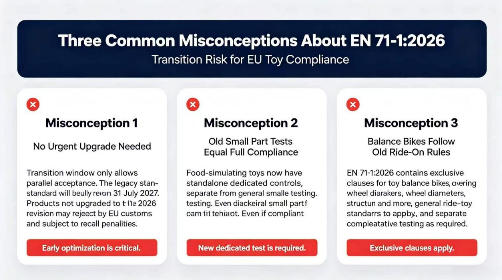
Many toy exporters hold flawed understandings during the transition period, leading to compliance failures, customs holds and product recalls. Three typical pitfalls are summarized below:
❌ Misconception 1: No urgent upgrade needed as old standards remain usable during transition The transition window only allows parallel acceptance of both versions. The legacy standard will be fully revoked on 31 July 2027. Products not upgraded to meet the 2026 revision will be rejected by EU customs and subject to recall penalties; early optimization is critical to mitigate risks.
❌ Misconception 2: Food-simulating toys pass old-version small part tests = fully compliant The new standard introduces standalone dedicated controls for food-simulating toys, separate from general small part testing. Even if compliant with the old standard, products without the new dedicated test pass result will be deemed non-conforming.
❌ Misconception 3: Toy balance bikes can follow general old ride-on toy requirements EN 71-1:2026 contains exclusive clauses for toy balance bikes with rigid fixed indicators for brakes, wheel diameters, structural strength and more. General ride-on toy standards no longer apply, and separate dedicated compliance testing is required.


 English
 日本語
日本語 français
 Deutsch
 Español
 italiano
 русский
 português
 العربية
 Türkçe
 dansk
dansk