RoHS certification refers to testing and compliance certification that restricts the use of hazardous substances in electrical and electronic products. It verifies that products meet environmental requirements for sale in the EU and other markets.

RoHS (Restriction of Hazardous Substances) is a mandatory environmental directive established by the European Union. It aims to restrict the use of lead, mercury, cadmium, hexavalent chromium, polybrominated biphenyls (PBB), polybrominated diphenyl ethers (PBDE), and certain phthalates in electrical and electronic equipment. This reduces environmental pollution and risks to human health, such as nervous system damage, liver and kidney toxicity, and carcinogenic hazards. RoHS certification is not merely a “certificate”. Manufacturers engage accredited third-party laboratories to test hazardous substance levels in products, and obtain test reports and certificates of conformity.
RoHS applies to all electrical and electronic equipment sold in the EU market, including:
· Household appliances: refrigerators, washing machines, microwave ovens, air conditioners, vacuum cleaners, water heaters, etc.
· IT and telecommunications equipment: computers, printers, mobile phones, digital products, televisions, audio systems, as well as medical devices, monitoring instruments, power tools, electronic toys, etc.
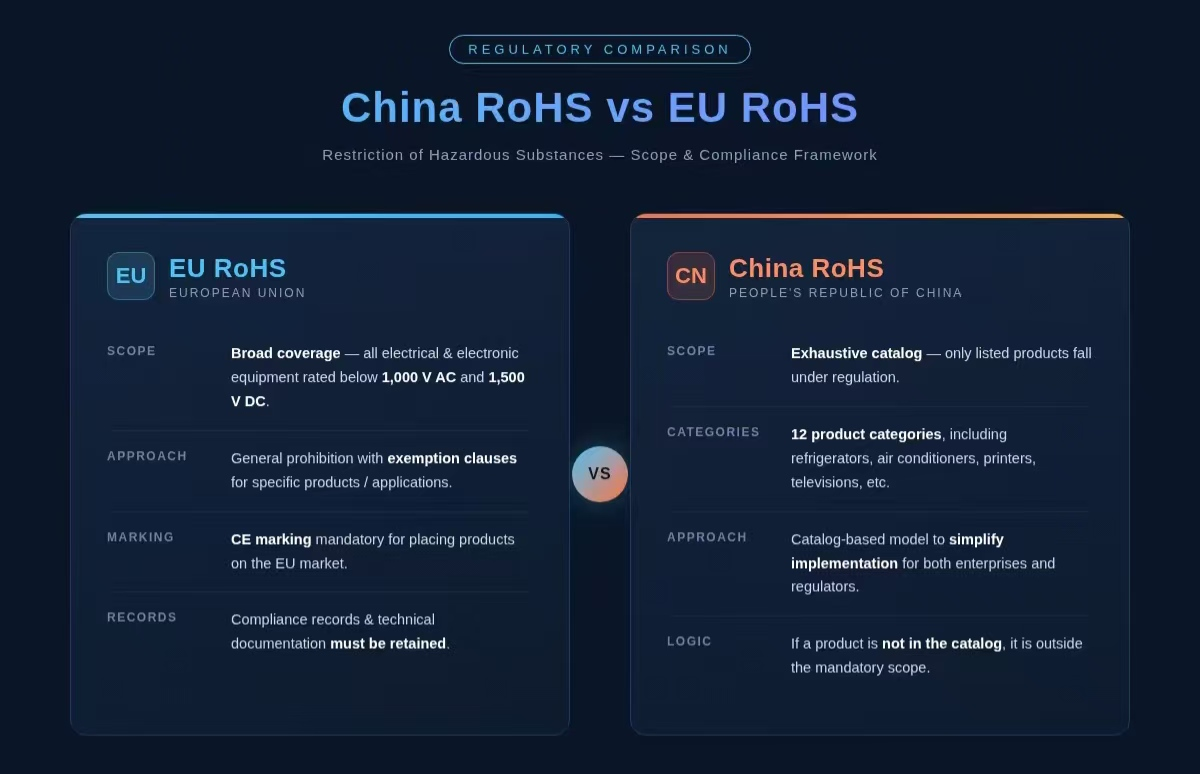
China has issued equivalent regulations. The Measures for the Administration of Pollution Control by Electronic Information Products took effect in 2006. The mandatory national standard GB 26572-2025 was released in 2025, expanding the controlled substances to 10 items. It will be officially implemented on August 1, 2027.
Limit Requirements
Cadmium ≤ 0.01% by weight; all other hazardous substances ≤ 0.1% by weight in homogeneous materials.
Retention of Technical Documentation
Manufacturers must retain technical documentation for at least 10 years and provide a declaration of conformity.
CE Marking
Products for the EU market must bear the CE mark to demonstrate RoHS compliance.
Testing and Certification
Products shall be tested by accredited third-party laboratories. Qualified products will receive RoHS test reports and certificates.
Covers a broad scope: all electrical and electronic equipment rated below 1,500 V DC and 1,000 V AC. Certain products qualify for exemption clauses. CE marking and compliance records are required.
Adopts an exhaustive product catalog listing compliant products (12 categories including refrigerators, air conditioners, printers, televisions, etc.) to simplify implementation for enterprises and regulators.
Market access: a prerequisite for entering the EU and other markets adopting RoHS rules. Compliance model: products must meet hazardous substance limits, carry proper CE marking, and maintain technical files plus an EU declaration of conformity.
Controlled Substances (RoHS 10 Substances)
Lead (Pb), Cadmium (Cd), Mercury (Hg), Hexavalent Chromium (Cr(VI)), Polybrominated Biphenyls (PBBs), Polybrominated Diphenyl Ethers (PBDEs), Bis(2-ethylhexyl) phthalate (DEHP), Dibutyl phthalate (DBP), Benzyl butyl phthalate (BBP), Diisobutyl phthalate (DIBP).
1. Environmental protection & sustainable development: promotes green design and manufacturing, and reduces hazardous substance emissions.
2. Enterprise risk control: non-compliant products may be banned from sale, subject to heavy fines, or even trigger criminal liability.
3. Improved brand image: RoHS-compliant products build an eco-friendly brand and strengthen consumer trust.
1. Product submission: send electrical and electronic products to an accredited third-party laboratory.
2. Testing & analysis: test the content of lead, mercury, cadmium, hexavalent chromium, PBBs, PBDEs and phthalates.
3. Report issuance: qualified products obtain RoHS test reports and certificates. Non-compliant products require material replacement or design revision.


 English
 日本語
日本語 français
 Deutsch
 Español
 italiano
 русский
 português
 العربية
 Türkçe
 dansk
dansk