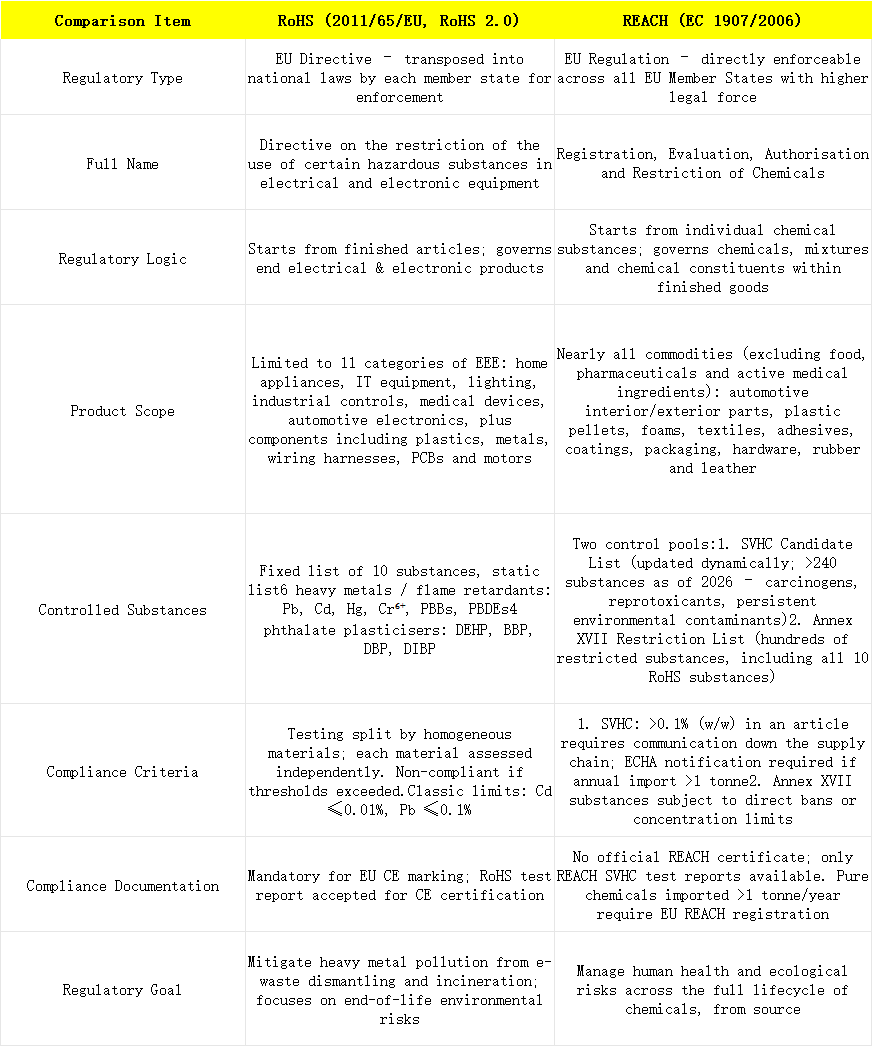
RoHS = Restriction regime exclusive to electrical and electronic products, enforcing fixed limit values for 10 hazardous substances. REACH = EU overarching chemicals regulation, full-life-cycle control for thousands of substances across nearly all industries. Its scope fully covers RoHS.
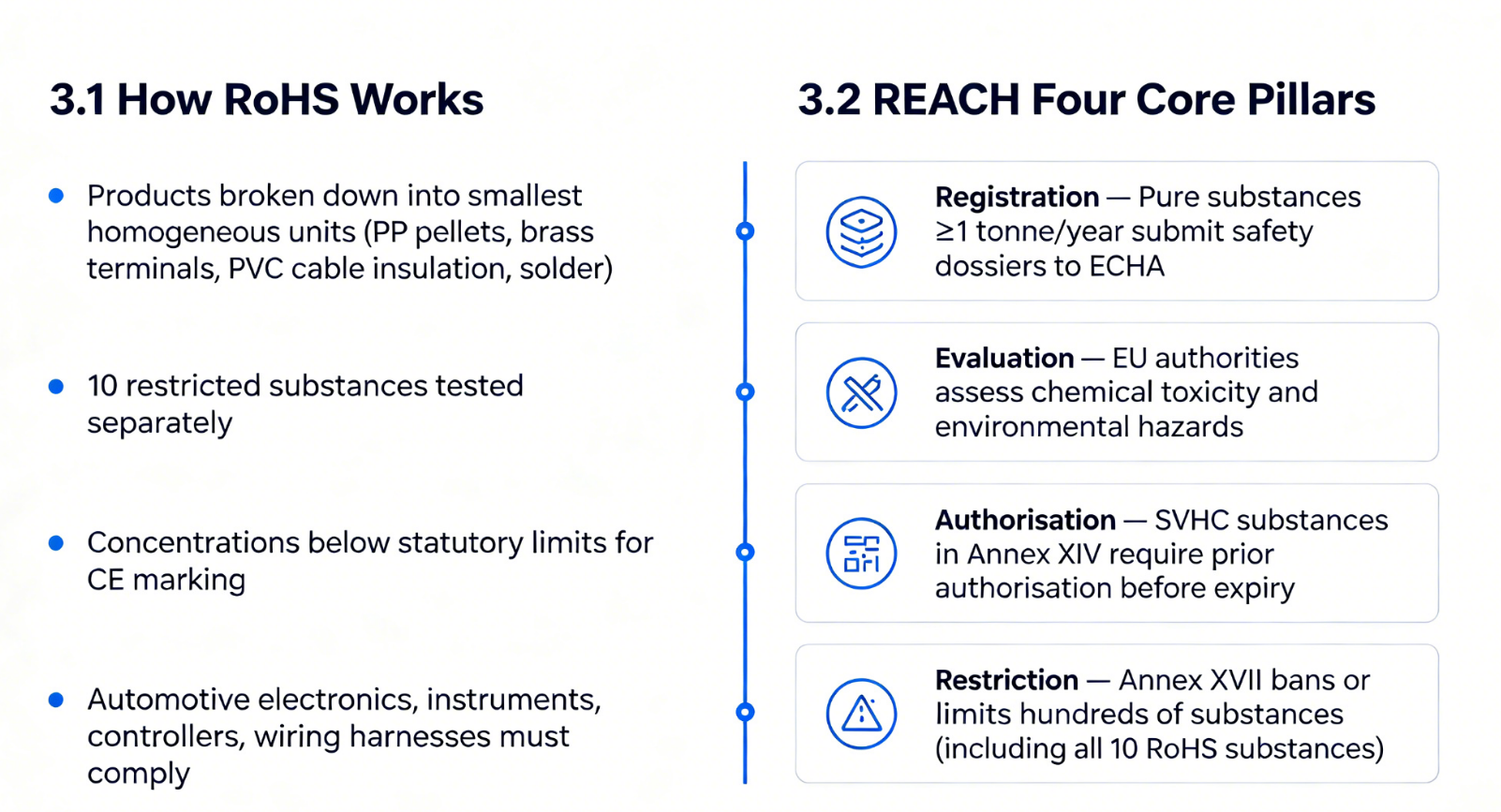
Products are broken down into smallest homogeneous units (e.g. PP pellets, brass terminals, PVC cable insulation, solder). The 10 restricted substances are tested separately. Outside applicable exemptions, concentrations must stay below statutory limits to carry CE marking for EU export. Automotive electronics, instruments, controllers and vehicle wiring harnesses must comply with RoHS.
· Registration: Pure substances manufactured or imported at ≥1 tonne/year must submit safety dossiers to ECHA.
· Evaluation: EU authorities assess chemical toxicity and environmental hazards.
· Authorisation: High-risk SVHC substances listed in Annex XIV require prior authorisation for continued use before expiry.
· Restriction: Annex XVII imposes direct bans or strict limits on hundreds of substances (including all 10 RoHS substances).
1. Inclusion relationship All 10 RoHS restricted substances are listed under REACH Annex XVII; REACH scope fully encompasses RoHS.
2. Compliance priority Where the same substance is regulated under both rules, the stricter limit applies. Example: RoHS lead limit of 0.1% is adopted under REACH.
3. EU export rules for automotive parts Vehicle PCBs, circuit boards, sensors, displays and on-board chargers: require both RoHS and REACH SVHC reports. Dashboard foam, seat PIP foam, plastic housings, rubber seals and leather: only REACH required (not classified as EEE finished goods, so RoHS does not apply).
RoHS: EEE-only, fixed 10 substances, homogeneous material testing, tied to CE marking.
REACH: universal for most product types, dynamic hundreds-of-substances list, supply-chain communication, source-level chemical control.


 English
 日本語
日本語 français
 Deutsch
 Español
 italiano
 русский
 português
 العربية
 Türkçe
 dansk
dansk