The CPSC (Consumer Product Safety Commission) is an independent agency of the United States federal government established in 1972. Its mission is to protect consumers from injuries caused by unsafe consumer products. CPSC safeguards public safety in consumer product use by formulating and enforcing safety standards, conducting market surveillance, and investigating product safety incidents.
CPSC covers a wide range of consumer goods including toys, children’s products, home appliances and furniture. Its core responsibilities are listed below:
· Develop and enforce safety standards: Set safety requirements for various consumer goods, which manufacturers must comply with to sell products legally in the US market.
· Market surveillance: Conduct sampling and oversight on commercially available products to verify regulatory compliance.
· Incident investigation and product recall: Mandate product recalls when non compliant goods present potential safety hazards.
CPSC ensures consumer product safety through the following measures:
· Standard setting: Issue detailed safety specifications, such as ASTM F963 for toys and flammability requirements for children’s garments.
· Third party testing: Children’s products must be tested by CPSC accredited third party laboratories to demonstrate compliance with all applicable safety requirements.
· Incident response: Publish public recall notices for non compliant products on a regular basis.
On January 8, 2025, multi purpose children’s helmets imported by XX Company were recalled for failing to meet CPSC federal safety requirements for bicycle helmets. The helmets could not provide adequate impact protection during collisions and posed a risk of head injury. Violations included requirements for helmet positional stability, impact absorption, labeling and certification.
Recall Details
· Hazard: The helmets failed to satisfy federal CPSC bicycle helmet requirements for positional stability, impact absorption, labeling and certification. They may not protect users effectively in crashes and present head injury risks.
· Affected units: Approximately 6,500 helmets.
· Remedial action: Consumers shall stop using the recalled helmets immediately and contact XX Company for a full refund. To submit proof of destruction for refunds, consumers must cut the helmet straps, take photos, and send them together with Amazon order numbers to the designated email address of XX Company.
The CPC (Children’s Product Certificate) is a certificate of conformity issued by manufacturers or importers to verify that products comply with CPSC safety standards. It applies to all products intended for children aged 12 and under, including children’s toys, apparel and baby articles.
· Age group scope: CPC applies exclusively to goods for children aged 12 and below. Products for different age brackets shall meet corresponding safety standards.
Key requirement examples:
· Lead content limits: Under the CPSIA (Children’s Product Safety Improvement Act), lead content in children’s products shall not exceed 100 ppm. This requirement applies to coatings, accessories, toys and other children oriented articles.
· Small part requirements: Under ASTM F963 and CPSC rules, small components in toys and children’s products shall minimize choking hazards. Specifically, toys for children under 3 years old shall contain no easily detachable small parts.
· Mechanical safety requirements: In accordance with ASTM F963 and CPSIA, children’s products (especially toys and garments) shall be free of sharp edges, readily detachable small parts, loose assemblies and other mechanical hazard sources.
· Flammability requirements: Per 16 CFR Part 1610, fabrics for children’s garments and toys must satisfy specified flammability criteria, notably sleepwear and textile based articles for children under 3 years old.
Applicable standards and test items vary by product category.
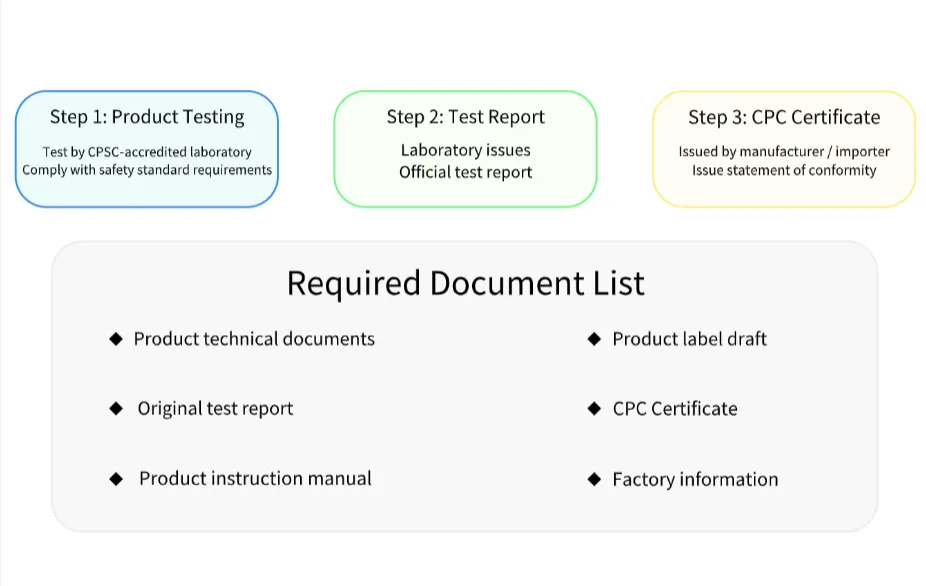
1. Product testing: Test products against applicable CPSC standards at a CPSC accredited third party laboratory.
2. Test report: Obtain formal test reports issued by the third party laboratory upon completion of testing.
3. CPC issuance: Manufacturers or importers generate a CPC statement of conformity based on third party test reports to confirm compliance with all applicable safety standards.
2.4 Requirements for CPSC accredited Third party Laboratories
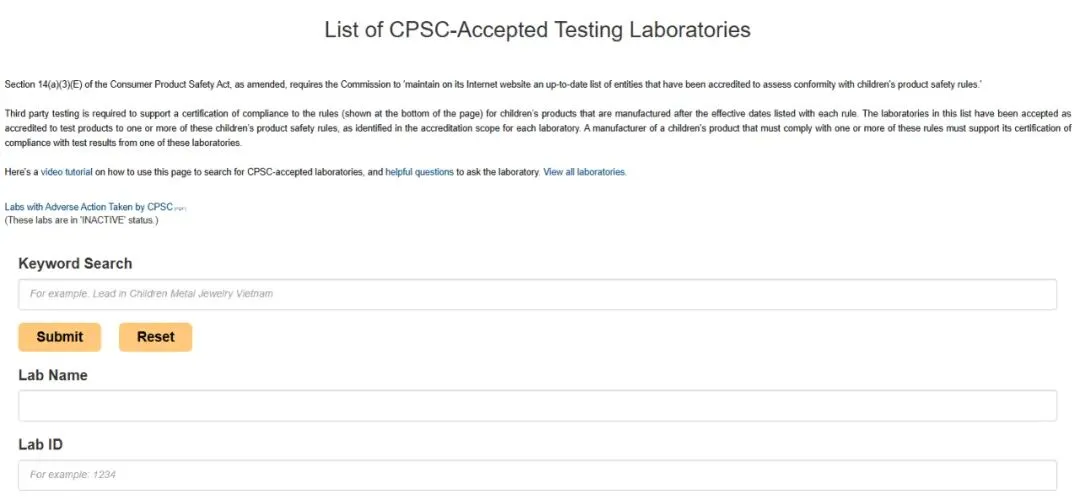
Information on CPSC recognized laboratories is available on the official CPSC website.
CPSC (Consumer Product Safety Commission) is a US federal regulatory body that develops and enforces consumer product safety standards. CPSC itself does not perform certification work. Instead, it mandates manufacturers and importers to prove compliance via CPC certificates.
The CPC (Children’s Product Certificate) is a document issued by manufacturers or importers to prove that goods satisfy CPSC safety requirements for children’s articles. It covers toys, children’s clothing, baby goods and other merchandise for children aged 12 and under.
To summarize: CPSC is the regulatory authority; CPC is the compliance evidence document.
· CPSC regulation: CPSC governs market product safety by publishing concrete standards and requirements.
· CPC certification: Importers must provide CPC certificates when shipping children’s products into the United States to demonstrate compliance with relevant US safety rules.
In short: CPSC regulatory obligations drive enterprises to obtain CPC certificates as proof of compliance with CPSC safety provisions.
· Select qualified testing laboratories: Pre market testing must be completed by CPSC accredited third party labs to maintain CPC validity.
· Clarify certification obligations: Different children product categories are subject to distinct safety standards. Confirm category specific requirements to avoid market recalls triggered by non compliance.
CPC certificates are critical for children product compliance when accessing the US market. CPSC, as the regulatory authority, sets safety standards, while CPC serves as the conformity certificate proving product compliance. Enterprises must conduct testing via CPSC accredited third party laboratories and issue valid CPC certificates to sell children’s products legally in the United States. Proper understanding and implementation of this compliance system help businesses meet regulatory obligations and mitigate risks of product recalls and legal penalties.


 English
 日本語
日本語 français
 Deutsch
 Español
 italiano
 русский
 português
 العربية
 Türkçe
 dansk
dansk