With increasingly frequent global trade, equipment exports have become a key way for enterprises to expand international markets. However, countries and regions worldwide have strict safety and compliance requirements for imported products. Among them, EU CE certification is an essential threshold for all export-oriented enterprises.
CE certification only covers the basic safety requirements to ensure products pose no danger to humans, animals, or property, rather than general quality standards. EU harmonized directives only stipulate essential requirements, while detailed standard specifications are defined by unified industry standards. Precisely speaking, the CE mark is a safety compliance mark, not a quality certification mark, and it constitutes the core essential requirement of European directives.
CE stands for Conformité Européenne, meaning “Conforms to European Standards”. It is a mandatory product safety compliance mark rather than a product quality certification.
Products affixed with the CE mark prove compliance with all health, safety, environmental protection, and consumer protection directives and regulations within the European Economic Area (EEA), including the 27 EU member states, Iceland, Liechtenstein, Norway of the European Free Trade Association (EFTA), and Switzerland under bilateral agreements.
The CE mark serves as the market passport for products entering Europe. Products falling under CE directive scope without valid CE marking are prohibited from circulation and sales across the EEA. It is not only a legal obligation of manufacturers but also a guarantee for consumer safety.
As a mandatory market entry qualification for the EU and EEA, CE certification delivers core advantages in market access, risk prevention, commercial competitiveness, brand credibility, and internal standardized management:
CE certification is the primary prerequisite for legal product sales in the EU market. Non-compliant products without CE marking face sales bans, off-market recalls, and heavy fines. For instance, many enterprises have suffered severe economic losses and reputational damage due to customs detention caused by uncertified exported products. Therefore, CE certification is indispensable for enterprises targeting European markets.
A CE mark indicates that the product has passed strict safety tests and compliance assessments and fully meets EU standards. For consumers, it represents reliable safety performance. Taking children’s toys as an example, CE-certified products pass rigorous material and design tests to eliminate health hazards, enabling safe consumption.
In a fiercely competitive global market, CE-certified products gain obvious competitive advantages. The CE mark symbolizes standardized safety and reliable quality, representing enterprises’ commitment to product quality. Consumers prefer CE-marked products due to verified compliance. Enterprises with CE certification effectively improve market recognition, gain customer trust, and stand out in international competition.
CE-certified products can circulate freely among all EU member states without repeated testing and certification in individual countries. This greatly simplifies cross-border trade procedures and eliminates technical trade barriers. For export enterprises, CE certification optimizes overseas sales channels and facilitates global market expansion.
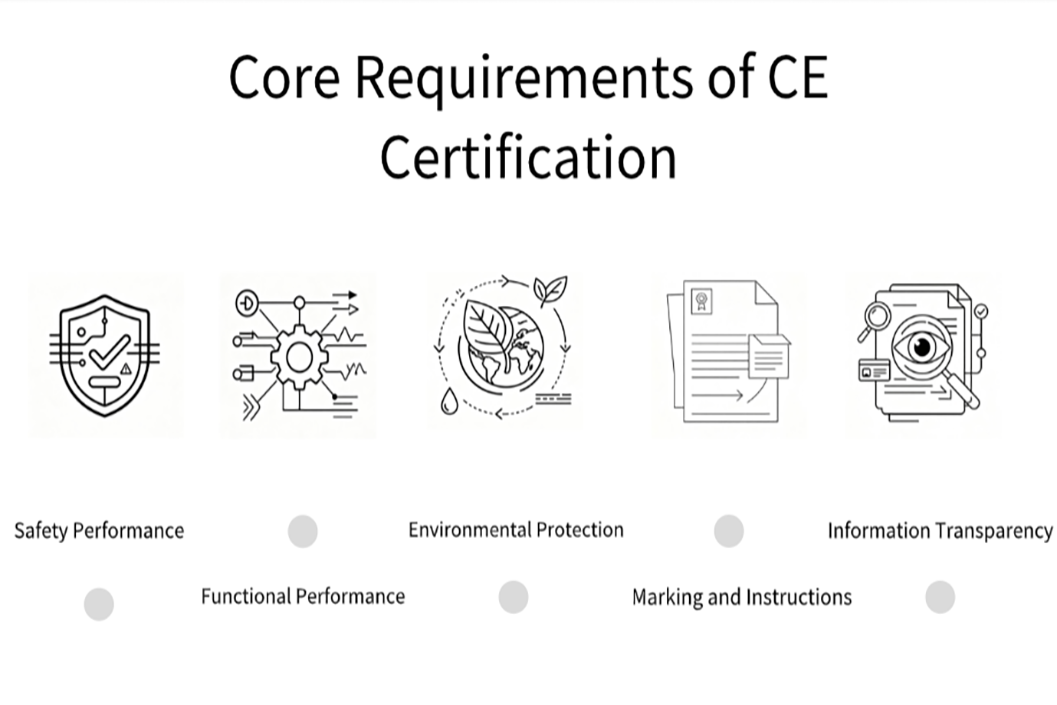
The core objective of CE certification is to ensure products cause no harm to human health, personal safety, ecological environment, and public interests (including energy efficiency and consumer protection) during design, production, and application. Specific requirements are as follows:
As the top priority of CE certification, product safety must comply with EU health and safety standards to eliminate risks such as electric shock, fire, explosion, mechanical injury, chemical hazards, and radiation hazards.
Products shall meet specific functional and performance standards according to product characteristics to ensure normal and stable operation, such as spectrum efficiency of wireless devices and measurement accuracy of precision instruments.
Products must comply with EU environmental regulations, including the RoHS directive on hazardous substance restriction, WEEE directive on waste electronic and electrical equipment recycling, and ErP directive on eco-design for energy-related products, to reduce pollution, waste discharge, and energy consumption.
Products must be printed with clear, legible, and durable CE marks, equipped with complete specifications, warning labels, and user manuals in official EU languages, ensuring safe installation, operation, maintenance, and disposal.
Enterprises shall fully disclose product performance parameters and technical information to ensure product functions meet unified EU testing and evaluation standards.
Enterprises need to prepare the following core technical documents for CE application:
• Electrical schematic diagram
• Electrical component list
• Hydraulic and pneumatic schematic diagrams and component lists
• Certification certificates of key components
• Product dimension drawings and structural drawings of safety parts
• English user manuals, nameplates, and warning label drawings
• EU Declaration of Conformity (DoC)
• Photos of finished installed prototypes
• ISO 9001 quality management system certificate
• Design calculation documents and safety loop descriptions
CE certification covers most industrial and consumer products. Any product that may pose potential risks to health, safety, or environment falls within the CE compliance scope. Main product categories are as follows:
Electronic and Electrical Products: Household appliances, consumer electronics, lighting equipment, audio-visual equipment, information technology equipment, etc.
Machinery Equipment: Power tools, industrial machinery, agricultural machinery, construction machinery, and related spare parts.
Personal Protective Equipment (PPE): Safety helmets, goggles, protective gloves, reflective vests, etc.
Medical Devices: Thermometers, bandages, diagnostic equipment, surgical instruments, and other medical equipment.
Toys: All toys for children under 14 years old to ensure physical, chemical, and flame retardant safety.
Construction Products: Building materials, doors and windows, thermal insulation materials, fire-fighting equipment, etc.
Pressure Equipment: Boilers, pressure vessels, pressure pipelines, etc.
Gas Appliances: Gas stoves, water heaters, and related gas equipment.
Measuring Instruments: Weighing scales, metering equipment, fuel dispensers, etc.
Radio Frequency Equipment: Mobile phones, Wi-Fi devices, Bluetooth devices, wireless remote controls, IoT terminals, etc.
The CE certification process varies according to product risk levels. The standardized procedures are as follows:
Determine the corresponding EU directives and harmonized EN standards based on product attributes. Different products match different compliance combinations (e.g., electrical products comply with LVD+EMC directives; LED lamps comply with EN 60598 standard).
Submit technical documents and product samples for professional testing by qualified laboratories, including electrical safety, EMC electromagnetic compatibility, hazardous substance detection, and customized item tests. Products failing the test will be rectified per official suggestions until fully compliant.
Complete standardized EU technical files (Technical File), including test reports, design drawings, product manuals, risk assessment reports, and Declaration of Conformity, for EU regulatory random inspection.
For low-risk products such as ordinary household appliances, enterprises may issue a self-declaration of conformity (DoC) after passing testing and affix the CE mark independently. For high-risk products such as medical devices, intervention, review, and certification by an EU Notified Body are mandatory before CE marking.
The CE mark must be clearly visible, readable, wear-resistant, and compliant with standard specifications (minimum height of 5mm). Qualified products with standard CE marks are legally circulated and sold across the European Economic Area.
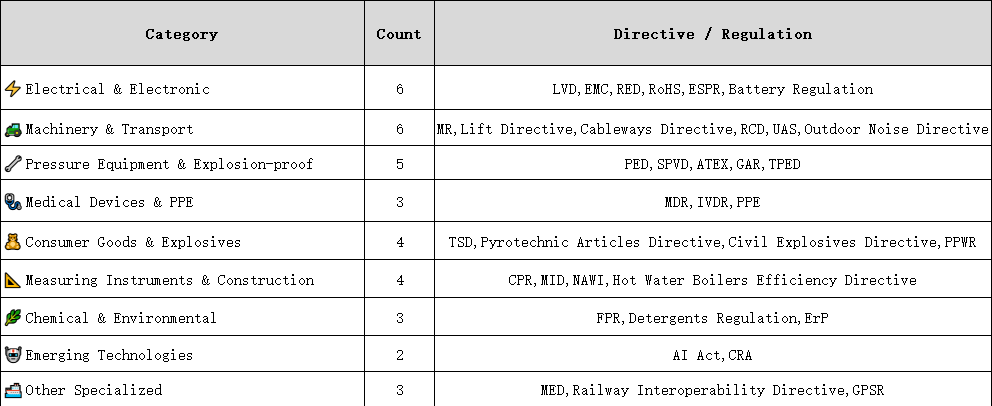
CE marking indicates full compliance with EU unified directives and regulations. There is no single universal CE standard; products adopt combined directives according to category, function, and risk level. The core mainstream directives are classified as follows:
LVD Low Voltage Directive (2014/35/EU)
Scope: Electrical equipment with AC 50–1000V and DC 75–1500V.
Typical products: Household appliances, lamps, power adapters, chargers, power tools.
Core requirements: Electrical safety, electric shock prevention, fire prevention, temperature rise control.
EMC Electromagnetic Compatibility Directive (2014/30/EU)
Scope: All electrically powered equipment that generates or is susceptible to electromagnetic interference.
Typical products: TVs, computers, routers, household and industrial electrical equipment.
Core requirements: Electromagnetic emission (EMI) control and electromagnetic immunity (EMS).
RED Radio Equipment Directive (2014/53/EU)
Scope: All equipment using radio spectrum signals.
Typical products: Mobile phones, Bluetooth headsets, Wi-Fi routers, drones, IoT devices.
Core requirements: RF frequency, transmit power, spurious radiation, and network security assessment.
RoHS Hazardous Substance Restriction Directive (2011/65/EU)
Scope: All electronic and electrical products driven by electric current or electromagnetic fields.
Typical products: Circuit boards, wires, batteries, electronic components.
Core requirements: Restriction of lead, mercury, cadmium, and other harmful substances.
EU Battery Regulation (2023/1542)
Scope: Portable batteries, power batteries, industrial batteries.
Typical products: Mobile batteries, new energy vehicle batteries, energy storage batteries.
Core requirements: Full-life safety control, carbon footprint accounting, and standardized labeling.
MD Machinery Directive (2006/42/EC & 2023/1230)
Scope: All mechanical devices with moving parts, such as machine tools, packaging machinery, agricultural machinery, elevators, and industrial robots.
Core requirements: Mechanical protection, risk assessment, structural strength, and noise control.
MDR Medical Device Regulation (2017/745)
Scope: All diagnostic, therapeutic, and implantable medical devices.
Core requirements: Medical safety, clinical evaluation, and UDI registration.
IVDR In Vitro Diagnostic Regulation (2017/746)
Scope: In vitro diagnostic reagents and equipment such as blood glucose meters and antigen test kits.
PPE Personal Protective Equipment Regulation (2016/425)
Scope: Safety protective equipment including helmets, goggles, gloves, and gas masks.
CPR Construction Products Regulation (EU 305/2011)
Scope: All construction materials such as cement, doors and windows, thermal insulation, and fire-fighting materials.
Core requirements: Structural performance, fire resistance, hygiene, and environmental protection.
Toy Safety Regulation (2025/2509)
Scope: All toys for children under 14.
Core requirements: Mechanical physical performance, flame retardancy, chemical migration limit, and privacy protection for smart toys.
PED Pressure Equipment Directive (2014/68/EU)
Scope: Pressure vessels, boilers, safety valves, and pressure pipelines.
Core requirements: Pressure resistance safety and compliance assessment.
ATEX Explosion-Proof Directive (2014/34/EU)
Scope: Equipment used in flammable and explosive environments such as explosion-proof motors and detectors.
Core requirements: Explosion-proof grade and temperature group compliance.
MID Measuring Instruments Directive (2014/32/EU)
Scope: Water meters, electricity meters, gas meters, fuel dispensers, and other metering equipment.
Core requirements: Measurement accuracy and legal metrology compliance.
EU AI Act (2024/1689)
Scope: Risk-classified AI systems; mandatory CE marking for high-risk AI equipment.
Core requirements: AI operational safety and risk compliance assessment.
CRA Cyber Resilience Act (2024/2847)
Scope: Digital products including smart home devices and industrial control systems.
Core requirements: Product network security and anti-risk capability.
9. General Universal Regulations
GPSR General Product Safety Regulation (EU 2023/988)
Scope: Consumer goods without dedicated directives, such as furniture and sports equipment.
Core requirements: General safety compliance baseline.
Note: Most products require compliance with multiple directives simultaneously. For example, smartphones comply with RED + RoHS + Battery Regulation; ordinary household appliances comply with LVD + EMC + RoHS. Enterprises shall match directives accurately according to product functions, materials, and application scenarios.


 English
 日本語
日本語 français
 Deutsch
 Español
 italiano
 русский
 português
 العربية
 Türkçe
 dansk
dansk