This test simulates the action of children gripping protruding parts of toys with thumb and forefinger and twisting forcefully during play. It assesses whether the parts will lead to the following hazards under torque:
· Detach and become small parts (choking hazard)
· Generate sharp edges (laceration risk) or sharp points (puncture risk)
· Expose hazardous components such as springs, magnets and expanding materials
· Damage ventilation structures, locking devices or protective features of the toy
As one of the core tests for mechanical and physical properties of toys, this test is often performed in conjunction with the tension test (8.4.2.1). A clear sequence and conditional relationship apply to the two tests.
In accordance with scenarios referenced in EN 71-1:2026 Clause 8.3, the following toys or components must undergo the torque test:
Referenced Clause | Type of Toy / Component | Reason for Testing |
4.6 | Toys containing expanding materials | Prevent expanding materials from detaching into small parts, which may cause intestinal blockage if swallowed and expand inside the body |
4.11 | Mouth-actuated toys, mouth-accessible toys (mouthpieces, whistles, etc.) | Avoid part detachment leading to choking |
4.14 | Enclosed toys (parts around doors, lids and ventilation holes) | Prevent damage to ventilation or locking devices that could trap children |
4.17 | Projectile toys (suction cups, projectiles, protective caps) | Stop suction cups from detaching and blocking airways |
4.18 | Water / inflatable toys (inflation plugs) | Prevent plugs from being inhaled after detachment |
4.22 | Ball toys | Prevent balls from becoming choking hazards once detached |
4.23 | Toys with magnets | Avoid magnet detachment which may cause intestinal perforation |
4.25 | Toys attached to food | Prevent accidental ingestion of detached small parts |
4.28 | Imitation food toys (e.g. fake candies) | Prevent accidental ingestion of detached small parts |
5.1 | Toys intended for children under 36 months (general requirement) | Mandatory test to prevent small parts, sharp edges and sharp points |
5.10 | Ball toys for children under 36 months | Strictly prohibit ball detachment |
5.12 | Hemispherical toys (bowl-shaped or egg-shaped containers) | Prevent hemispherical parts from covering nose and mouth and causing suffocation |
5.13 | Suction cup toys | Prevent suction cups from detaching and blocking airways |
Clause 6 | Separable packaging components that are:• Balls (as defined in 4.22)• Or cylindrical parts with rounded ends (e.g. half capsules, cylindrical lids) | Prevent children from putting such packaging parts into mouth and causing airway blockage |
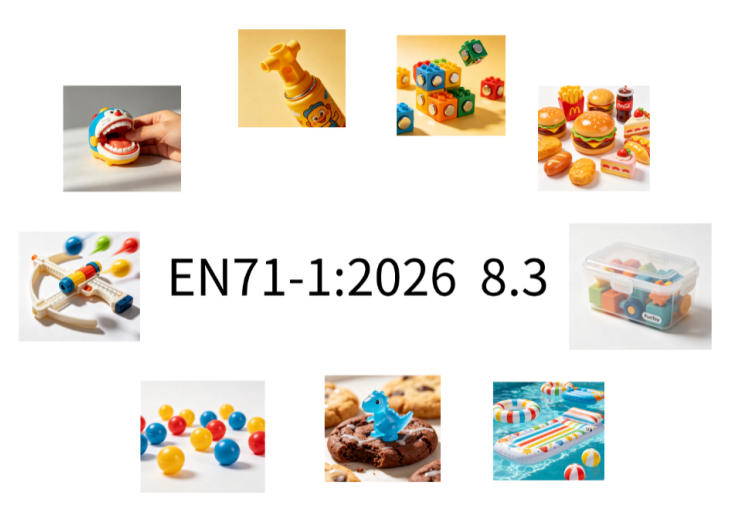
Important Note: For clauses marked with when tested according to 8.3 and 8.4.2.1, the torque test shall be conducted first. Whether to perform the subsequent tension test is determined based on the torque test results (see Section 5).
The torque test applies to parts grippable by thumb and forefinger. The judgment criteria are as follows:
Attempt to grip the part with thumb and forefinger. Parts that can be gripped (regardless of thickness, provided the protrusion length is sufficient): a) Slender rods (e.g. antennas, thin handles) b) Thick long grips (e.g. cranks, handholds) c) Spherical / hemispherical parts (with adequate protrusion) d) Flat thin pieces (with adequate protrusion) → Torque test required
If the part is too short or tiny to grip directly, insert a 0.4 mm thick feeler gauge (see Figure 26) into the gap between the part and the toy main body at an angle of 0°~10° with a force of (10 ± 1) N.
· Insertion depth > 2 mm: Regarded as grippable → Torque test required (fingers can reach into the gap to apply force)
· Insertion depth ≤ 2 mm: Regarded as non-grippable → Torque test not required (tension test may still be needed per relevant clauses)
Equipment | Requirements | Application |
Torque meter | Measuring range ≥ 0.5 Nm, accuracy ±0.02 Nm | Apply torque |
Clamp (optional) | Soft jaws to avoid damaging toys | Fix the toy to prevent overall rotation |
Marker pen | Fine tip with striking colour | Mark the original position of components |
0.4 mm feeler gauge | Refer to Figure 26, edge radius approx. 3 mm | Assess grippability |
Small parts cylinder (8.2) | Refer to Figure 25 | Determine whether detached parts are small parts |
Sharp edge tester (8.11) | Equipped with adhesive tape and rotating shaft | Detect sharp edges |
Sharp point tester (8.12) | Refer to Figure 30 | Detect sharp points |
Magnifier / Illuminator | 2~3 times magnification | Inspect cracks or tiny detached fragments |
Camera / Mobile phone | - | Record toy status before and after testing |
· Use brand-new toys that have not undergone any prior tests.
· Assemble the toy strictly in accordance with the instruction manual if assembly is required.
· Inspect and record all components subject to torque test (photos are recommended).
· For toys for children under 36 months (Clause 5), all grippable parts shall be tested.
· Temperature: 20 ± 5°C
· Humidity: No special requirements; avoid extremely dry environment to prevent plastic embrittlement.
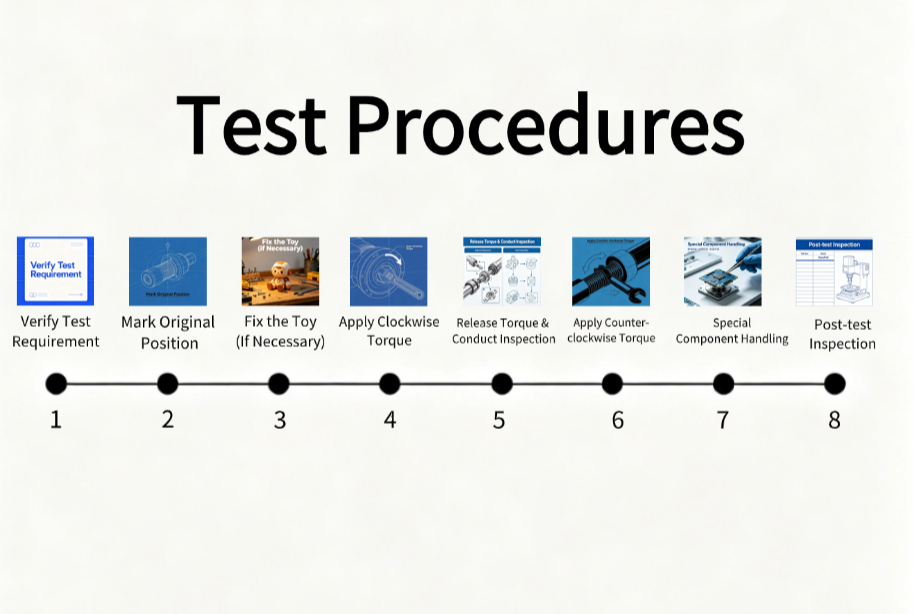
Determine whether the component needs torque test following the grippability criteria in 2.2.
Draw alignment lines on both the component and toy main body. Mark a reference point for round components such as spheres.
Secure the toy main body with a soft-jaw clamp if it tends to rotate as a whole. Do not clamp the test component or fragile areas.
1. Clamp the component with the chuck or adapter of the torque meter, as close to the root as possible.
2. Gradually increase the torque within 5 seconds; do not apply sudden impact force.
3. Stop the test once either condition is met: a) The component rotates by 180° from its original position b) The torque reaches 0.34 Nm
4. Maintain the torque or rotation angle for 10 seconds.
Slowly release the torque and let the component return naturally (do not reset it manually). Observe and record the following: a) Whether the rotation exceeds 180° b) Whether the torque reaches 0.34 Nm c) Cracks, breakage or detachment of the component d) Generation of sharp edges or sharp points
Repeat Step 4 and Step 5 in the counter-clockwise direction, and record all results.
If the component loosens before rotating 180° during torque application, continue applying torque until one of the following occurs: a) Torque reaches 0.34 Nm b) The component is completely unscrewed and detached c) Further loosening is impossible (e.g. thread slipping) Record the final status.
Clamp the shaft or rod first to prevent it from rotating together with the component, then apply torque to the component.
· Check for sharp edges and sharp points using the test methods in 8.11 and 8.12.
· Check for exposure of internal hazardous parts (springs, magnets, expanding materials, etc.).
· Keep records and decide whether to proceed with the tension test per relevant clauses (see Section 5).
· Collect all detached fragments.
· Perform small parts test (8.2): Place fragments into the small parts cylinder to judge if they fully pass through.
· Perform sharp edge test (8.11) and sharp point test (8.12).
· No tension test is required as the component no longer remains on the toy.
· Check if new sharp edges or sharp points are formed on the residual fixing structure.
Clamp the remaining part and decide whether to conduct the tension test per relevant clauses (see Section 5).
1. Always use a torque meter for gradual loading; do not twist by hand with brute force. Manual torque can easily exceed 0.34 Nm.
2. Grippability is judged by protrusion length and feeler gauge insertion depth, instead of merely component thickness.
3. Distinguish between rotation and slippage: If the component slips on smooth surfaces before rotating 180°, record the maximum torque value and confirm detachment status.
4. Threaded components that unscrew at torque below 0.34 Nm are regarded as detached; compliance of detached parts shall be assessed.
5. One complete test consists of clockwise and counter-clockwise torsion on a single component; repeated testing is unnecessary.
6. All identical components on one toy shall be tested individually (e.g. four wheels of a toy car).
7. A non-detached component does not equal safety: Still check for functional damage, cracks, sharp edges, sharp points and exposed hazardous parts.
8. Component detachment does not necessarily result in failure: If the detached part is reinstallable, does not affect toy functions, and is not a small part with no sharp edges/points, the toy may still pass for toys for children over 36 months.
9. Stricter requirements for toys for children under 36 months: Per 5.1 b), no small parts, sharp edges, sharp points, exposed magnets or springs are allowed after torque test.
10. Special requirement for suction cups: Per 5.13 a), detached suction cups shall not fully pass through Template E (small parts template), and all other requirements shall also be met.
Post-test Status | Applicable Clauses | Result |
Component attached; no cracks, sharp edges, sharp points or exposed hazardous parts | All clauses | ✅Pass |
Component attached with cracks but no sharp edges or sharp points | All clauses | ✅Pass |
Component attached but sharp edges or sharp points generated | 4.7, 4.8, 5.1 | ❌Fail |
Component attached but exposed magnets (per 4.23) which are classified as small parts | 4.23, 5.1 | ❌Fail |
Component attached but ventilation structures (4.14) or locking devices damaged | 4.14 | ❌Fail |
Component detached; detached part is not a small part and has no sharp edges / sharp points | Clauses for toys for children over 36 months | ✅Pass |
Component detached; detached part is a small part or has sharp edges / sharp points | All clauses | ❌Fail |
Suction cup detached and fully passes through Template E (5.13) | 5.13 | ❌Fail |
Special Remark for Toys for Children under 36 months (Clause 5):Any detached parts, sharp edges or sharp points are prohibited after torque test. The detachment itself is non-compliant even if the detached part is not a small part, unless explicitly exempted by relevant clauses.
1. Laboratory test report
2. Test photos and videos
Q1: Does a tiny component that cannot be gripped directly by thumb and forefinger require torque test? A: It depends.
· Slender components with sufficient protrusion (e.g. antennas): Grippable → Torque test required.
· Tiny components with short protrusion (e.g. small buttons with 2~3 mm protrusion): Use 0.4 mm feeler gauge per 8.4.2.1.
o Insertion depth > 2 mm → Torque test required
o Insertion depth ≤ 2 mm → Torque test not required
Q2: Is tension test needed if the component detaches after torque test? A: No. The tension test targets the original component which no longer exists. Only inspect the detached part for small parts, sharp edges and sharp points.
Q3: Is tension test needed if the component remains attached but has cracks after torque test? A: Yes. The tension test shall be performed on the same component, as tension may expand cracks or cause detachment and reveal potential hazards.
Q4: Is flexible rubber component acceptable if it deforms under torsion without detachment? A: It is acceptable if no detachment, sharp edges, sharp points or exposed hazardous parts occur. Record "flexible rubber deformation" in documents.
Q5: Do multiple identical components on one toy all need testing? A: Each component can be tested individually. Alternatively, test one sample; if it passes, the rest identical parts can be exempted (state this clearly in records).
Q6: Is the toy compliant if the detached part is not a small part but the toy is intended for children under 36 months? A: Fail. Per 5.1 b), any detachment is prohibited for toys for children under 36 months regardless of the size of detached parts, unless exempted.
Q7: Does the T-shaped plastic handle on packaging require torque test? A: No. Clause 6 d) only applies to packaging parts that are balls or cylindrical parts with rounded ends. T-shaped handles are excluded. However, if the handle is grippable during normal use and falls under other clauses (e.g. 5.1), relevant tests shall be conducted accordingly.
· 8.3 Torque test (Main test method)
· 8.4.2.1 Tension test, general (Tension test following torque test)
· 8.2 Small parts cylinder (Small part assessment)
· 8.11 Sharpness of edges
· 8.12 Sharpness of points
· 8.31 Magnetic flux index (Magnet safety assessment)
· 4.6, 4.11, 4.14, 4.17, 4.18, 4.22, 4.23, 4.25, 4.28, 5.1, 5.10, 5.12, 5.13, Clause 6 (Clauses referencing torque test)
HUAK Testing Certification Service Advantages
HUAK Testing covers an area of over 4,000 square meters, including EMC, RF, 5G NR/6G (RF), Safety, Physical, Battery, and Chemical testing laboratories. It supports a wide range of products—from consumer goods like mobile phones, computers, toys, apparel, footwear, and cosmetics, to industrial control equipment and smart home devices—helping clients meet global market access requirements. The company is equipped with internationally advanced professional testing equipment and has assembled an elite team of senior industry experts and technical professionals. Team members, with their solid professional knowledge and rich practical experience, are able to accurately interpret various complex standards and technical requirements. As a well-known third-party testing laboratory in China, HUAK has been recognized by many international organizations, including the China National Accreditation Service(CNAS) for Conformity Assessment and the US A2LA. HUAK Testing is also the designated testing and certification service provider for Amazon, and maintains close cooperation with internationally renowned notified bodies such as MICOM, element, MET, and Germany's PHOENIXTESTLAB GmbH.
PREV


 English
 日本語
日本語 français
 Deutsch
 Español
 italiano
 русский
 português
 العربية
 Türkçe
 dansk
dansk