Many enterprises hold CE, FCC and other European & American certifications, yet their shipments to Japan still get detained by customs, products removed from store listings, and heavy fines imposed.
There is only one core reason: lack of Japan’s local TELEC wireless certification.
As a mandatory access certificate for wireless devices entering the Japanese market, TELEC is an essential pass for all Bluetooth, Wi-Fi and RF wireless products exported to Japan.
TELEC certification is the technical conformity certification for radio equipment implemented by Japan’s Ministry of Internal Affairs and Communications (MIC) under the Japanese Radio Law, commonly known as the Giteki certification in the industry. It is a legally mandatory access requirement for wireless products to enter the Japanese market.
Many beginners tend to confuse related terms. The core relationship is clarified below:
Radio Law: Japan’s national law governing wireless devices (the rule basis)
MIC: Japan’s Ministry of Internal Affairs and Communications, the authority enforcing the Radio Law
TELEC: The specific certification certificate issued under the Radio Law (product compliance document)
Concise summary: TELEC certification serves as the spectrum compliance ID card for Japanese wireless devices. It specifically regulates wireless signals to prevent signal interference and unauthorized use of frequency bands.
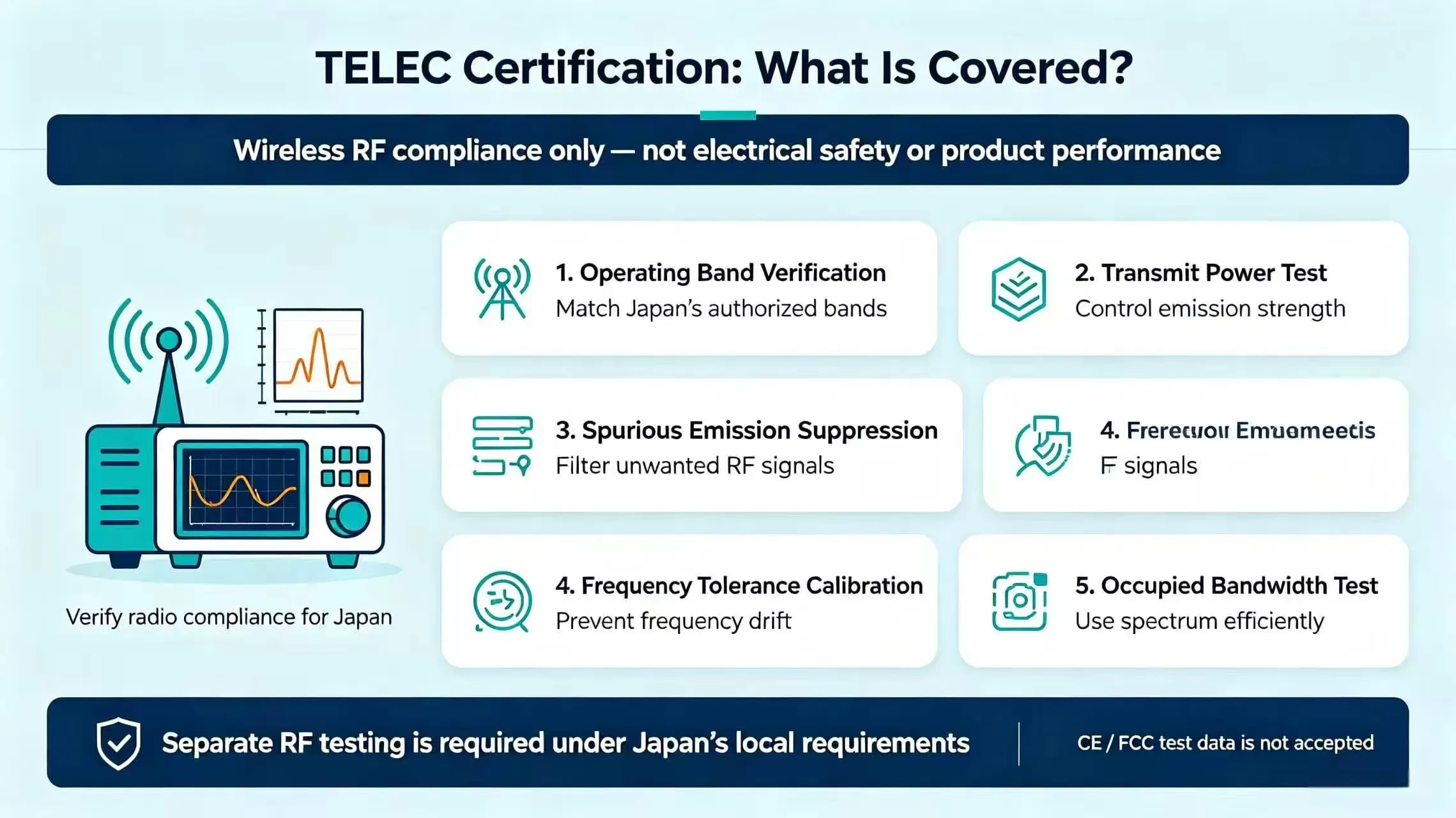
TELEC certification does not test electrical safety or product performance. It only focuses on wireless RF indicators to strictly verify radio compliance of products. Core test items are as follows:
· Operating frequency band verification: Strictly match Japan’s authorized frequency bands; occupation of regulated spectrum is prohibited to avoid band overrun.
· Transmit power test: Control signal emission strength of devices to prevent high power from interfering with public communications.
· Spurious emission suppression: Filter redundant RF spurious signals to avoid interference with base stations, broadcasting and civilian communication equipment.
· Frequency tolerance calibration: Ensure accurate device frequency bands and eliminate compliance risks caused by frequency drift.
· Occupied bandwidth test: Standardize signal coverage and rationally utilize Japan’s spectrum resources.
All tests comply with the latest official announcements issued by Japan’s MIC. Test data from European CE or US FCC certifications are not accepted, and separate RF testing following Japan’s local requirements is mandatory.
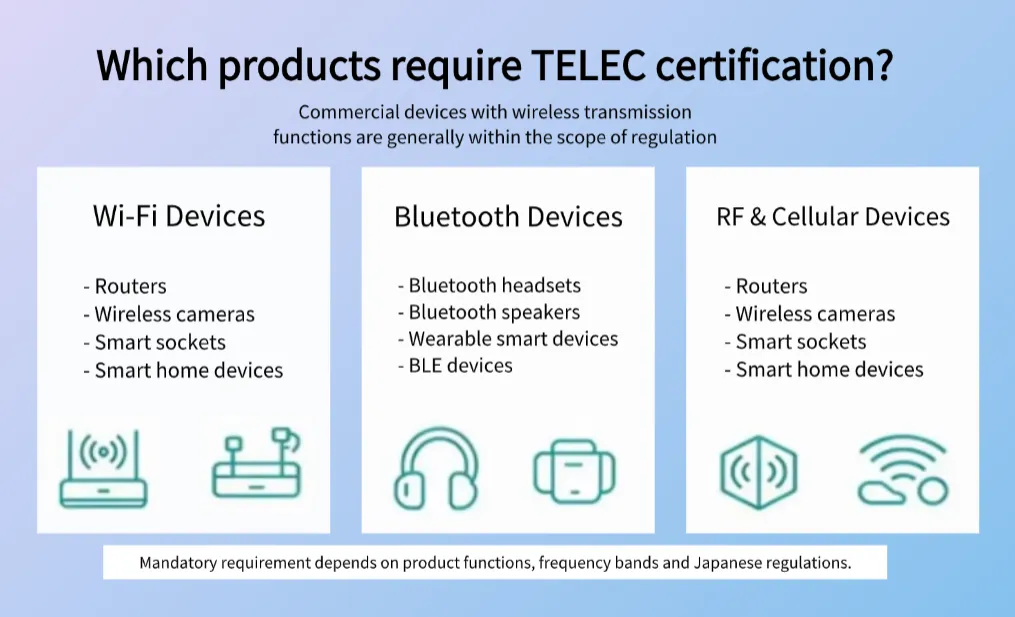
The scope of control under Japan’s Radio Law is extensive. Commercial products with active wireless transmission functions generally have no exemption and must obtain TELEC certification. Main product categories are listed below:
Wi-Fi Products
Wi-Fi 2.4G/5G/6G routers, wireless network adapters, wireless cameras, smart sockets, smart home terminals, complete machines with wireless modules, etc.
Bluetooth Products
Bluetooth earphones, Bluetooth speakers, Bluetooth wristbands & watches, Bluetooth remote controllers, BLE low-power Bluetooth devices, Bluetooth wearables, etc.
RF / Cellular Wireless Products
4G/5G IoT terminals, automotive wireless devices, wireless microphones, RF remote controllers, wireless alarms, wireless sensing equipment, etc.
Important reminder: Only a tiny number of ultra-low-power short-range devices may apply for exemption. Mass-produced commercial wireless products on the market are all subject to mandatory TELEC certification. Import, sale and use are prohibited without valid certification.
Starting in 2026, TELEC certification standards in Japan have been fully updated, with multiple old standards formally repealed. This has become a frequent pitfall for enterprises recently:
· From April 2026, all products shall adopt the latest ANEX standards uniformly. Reports under old standards are invalid and cannot be used for customs clearance or product listing.
· New 14-channel special test added for Bluetooth and Wi-Fi 2.4G products; missing this test will result in direct rejection of certification applications.
· 6G Wi-Fi devices are under strict control, with significantly tightened review criteria for RF parameters.
· Random certificate inspections have been intensified. If RF parameters of mass-produced products differ from those of the test samples, certificates will be revoked and products removed from sale.
Misconception 1: Holding FCC/CE certification exempts enterprises from TELEC for Japan
Correction: Spectrum rules and RF limit values vary widely across countries. Japan’s MIC does not recognize any overseas certifications. Foreign certificates cannot replace TELEC, and separate certification is required.
Misconception 2: If the module has TELEC certification, the finished product does not need certification
Correction: The module certificate is only valid for the module itself. If the finished product changes the antenna, modifies RF circuits or updates firmware parameters, RF indicators will change. Re-testing and re-certification are required; the module certificate cannot be reused directly.
Misconception 3: Low-power wireless products are eligible for TELEC exemption
Correction: Japan’s exemption requirements have strict quantitative thresholds; subjective judgment is invalid. Most commercial low-power wireless products fall under mandatory certification.
Misconception 4: TELEC and PSE certifications are interchangeable
Correction: TELEC governs wireless RF compliance while PSE governs electrical safety compliance. The two certifications are administered by different authorities and cover completely separate dimensions. Neither can replace the other. Electric products with wireless functions need both certificates.
Based on Japan’s official review rules, we have sorted out efficient compliance tips to help enterprises shorten lead times and avoid risks:
1. Pre-assessment: Confirm wireless frequency bands and emission parameters at the product development stage, align with the latest TELEC test standards, and prevent parameter non-compliance in advance.
2. Standard alignment: Conduct tests under the latest ANEX standards for all applications after 2026 to avoid invalid reports under old standards.
3. Document retention: Keep certificates, complete test reports and sample parameter records for long-term archiving to cope with customs inspections and annual market random checks.
4. Labeling specification: After certification approval, affix the TELEC Giteki mark and certification number on the product body as required. Products without the required mark are deemed non-compliant.


 English
 日本語
日本語 français
 Deutsch
 Español
 italiano
 русский
 português
 العربية
 Türkçe
 dansk
dansk