In August 2026, the Product-Safety Section under the Industrial Safety & Security Group of Japan’s Ministry of Economy, Trade and Industry (METI) formally released Initiatives Related to Product Safety, introducing stricter access requirements for battery-operated products. This official notice sends a major wake-up call to all Chinese exporters targeting the Japanese market, particularly manufacturers and sellers of power banks and battery-related goods.
This tough regulatory crackdown by Japanese authorities is a direct response to the worsening product-safety situation. The number of serious product-related accidents across Japan has been on the rise in recent years, with a growing proportion of incidents traced back to cross-border online purchases. Fueled by the boom in cross-border e-commerce, online shopping channels have become a hotbed for safety-related product incidents. Numerous unsafe items have reached Japanese consumers via online sales. Regulators have shifted their primary focus away from physical brick-and-mortar stores toward cross-border e-commerce.
Among various product categories, power banks exhibit prominent safety risks, and the volume of related accidents has increased substantially in recent years.
Why have power banks become a key target for rectification? Most accidents occur in confined public transport such as subways and buses. Battery fires or smoking events in crowded venues may easily trigger secondary disasters with significant social repercussions. This is the core reason why Japanese regulators are determined to stop substandard power-bank circulation at the source.
The most notable change under the new rule proposal: high-energy-density power banks will be moved from self-declaration under circular PSE to mandatory third-party testing under diamond PSE. This is a high-profile revision to Japan’s Electrical Appliance and Material Safety Law.
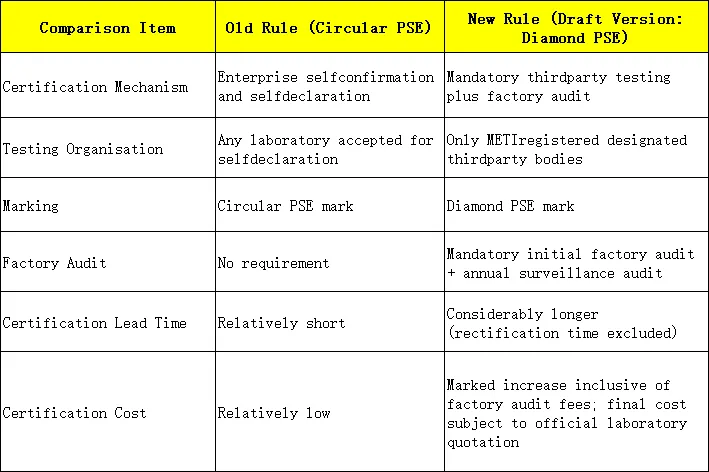
Per the draft proposal, power banks with high energy density will fall under the mandatory diamond PSE regime. Exact parameter thresholds and applicable product list await the official release of technical specifications. Companies are advised to sort out product specifications in advance and conduct preliminary risk assessment.
Violations carry severe penalties:
· Unauthorised sales without valid certification: Fines and legal sanctions for both legal entities and individuals
· Serious violations: Potential criminal liability |Platform Penalties|Product delisting, ASIN suspension and associated-account risks| |Inventory Impacts|FBA stock may be locked and blocked from sales|
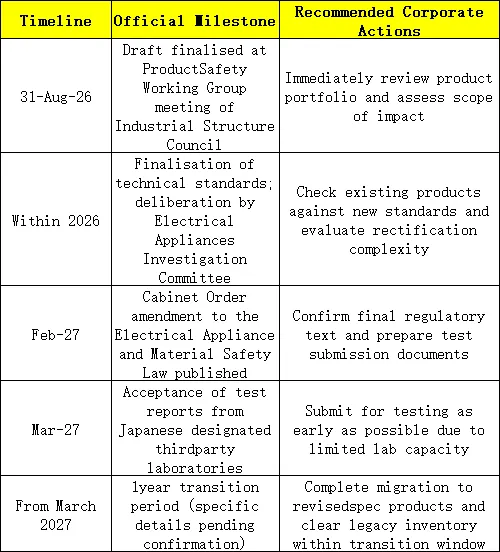
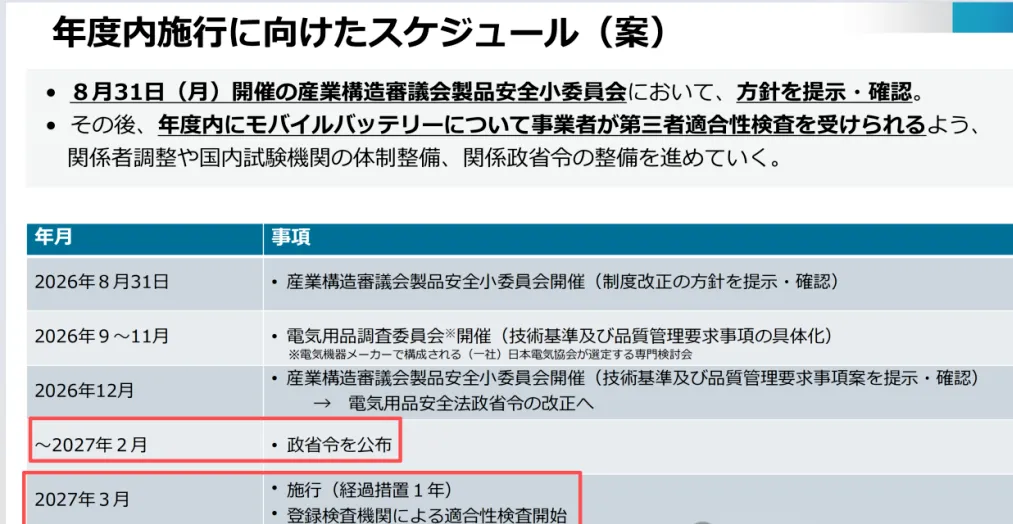
Japan’s regulatory approach is clear: instead of directly targeting individual sellers, authorities impose obligations on e-commerce platforms to enforce merchant compliance. Platforms covered under this joint-supervision framework include:Amazon Japan-Rakuten-Mercari-Yahoo! Shopping-Qoo10-Temu
Three core regulatory mechanisms:
1. Net Patrol: Routine online spot-checks run by platforms; non-compliant listings will be ordered for rectification or directly removed
2. Government-Platform Information Sharing: Regular information exchange on non-compliant sellers and defective products
3. Product Safety Commitment Framework: Mandatory removal of violating listings and periodic publication of unresponsive operator lists
Regulators keep expanding online inspection resources and adopt digital tools to strengthen web-based surveillance. This new regulation is far from empty paper legislation.
Facing this upcoming compliance overhaul, power-bank exporters to Japan should take five priority actions:
Compile core specifications for all active and in-development power-bank SKUs and implement classification-Assess which products may be captured by diamond PSE requirements-Separately flag items with extra functions such as wireless charging or Bluetooth for additional certification needs-Quantify on-hand inventory and in-transit FBA stock, formulate legacy-inventory clearance plan for transition period
Why early testing matters: Designated Japanese laboratories have limited capacity. Mass-scale submission will cause heavy scheduling backlogs. If tests fail and rectification is required, retesting will further extend timelines, which may result in missing the transition-period deadline. It is recommended to initiate pre testing and document preparation right away.
Strict incoming quality control for battery cells to eliminate manufacturing-related safety hazards - Establish or optimise quality-management systems as stipulated in the draft regulation - Prepare complete documentation for factory audits: production workflows, inspection records and traceability system records
Overseas sellers will be classified as Specified Importers and are required to engage a local agent in Japan. The local Japanese agent receives official regulatory notices, cooperates with investigations and assumes joint-and-several liability. Select qualified agent service providers well in advance rather than making last-minute arrangements.
Proactively contact platform account managers to obtain upcoming platform-specific compliance requirements - Prepare product documentation in advance: PSE certificates, test reports, Japanese manuals and warning labels Mitigate risk of sudden ASIN removal triggered by ad-hoc platform audits
Q1: I already hold circular PSE certificates. Do I need recertification? A: If your power-bank belongs to the high-energy-density category, an upgrade to diamond PSE may be required once the new rules take effect. Circular PSE is expected to remain valid for low-energy-density products. It is recommended to arrange a preliminary laboratory assessment to confirm your product category.
Q2: What happens if testing fails? How long will rectification take? A: Common power-bank test failures cover cell protection, housing flame retardancy, drop test, temperature-rise test and so forth. Rectification duration varies by product design; cell replacement will lead to longer lead-time. Pre-testing is highly recommended to identify defects early and avoid wasted test scheduling due to formal-test failures.
Q3: How long will the transition period last? A: The draft mentions a transition period yet detailed provisions have not been released. Do not count on a potential extension of the transition window. Plan according to the most stringent timeline for maximum safety margin.
Q4: Are there other compliance requirements besides PSE? A: Yes. Products with wireless charging, Bluetooth and other radio-frequency functions require relevant Radio Law certification. Product labelling must include Japanese warning statements and importer information. All these form indispensable parts of full compliance.


 English
 日本語
日本語 français
 Deutsch
 Español
 italiano
 русский
 português
 العربية
 Türkçe
 dansk
dansk