Covers 10 restricted substances,testing procedures & compliance risk avoidance
Factory owners and foreign trade merchants manufacturing home appliances, digital products,wiring harnesses,LEDs and other electrical and electronic goods for the EU market cannot avoid RoHS compliance.Many enterprises have encountered costly pitfalls: customs detention of shipments due to outdated 6-substance test reports,full container seizure over phthalate exceedance in plastic components,and failed customer factory audits from incomplete technical documentation.This article comprehensively explains everything about RoHS 2.0,including its definition,test items, product scope,testing workflows,differences from REACH, and common compliance misconceptions.
RoHS stands for Restriction of Hazardous Substances.It is a mandatory EU environmental access directive for electrical and electronic equipment, designed to regulate toxic hazardous substances in products and reduce harm to human health and pollution from electronic waste.
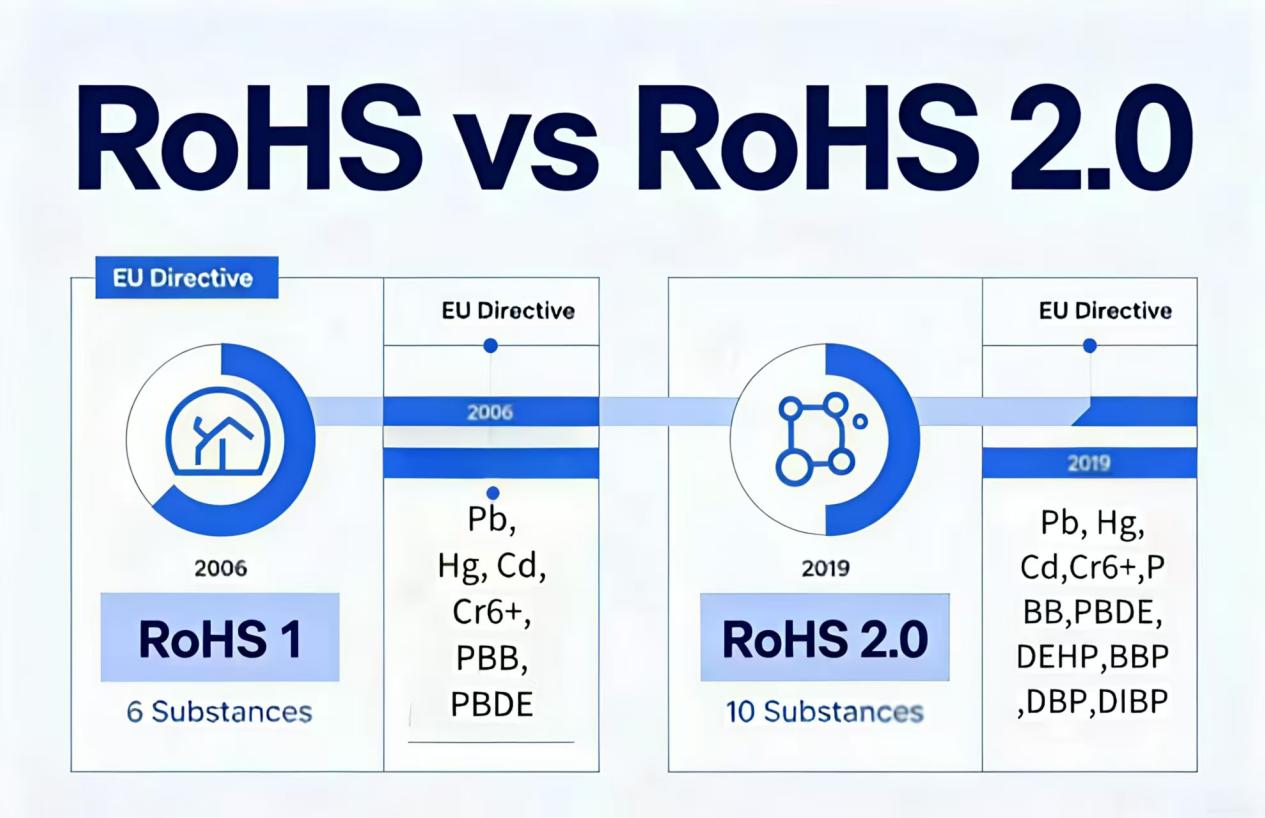
1. RoHS 1.0 (Old Version): Implemented in 2006 with controls over only 6 substances. It was fully phased out in 2013, and test reports covering merely these 6 substances are no longer accepted by EU authorities.
2. RoHS 2.0 (Current Mandatory Directive 2011/65/EU): Fully replaced the old version in 2013. Four additional phthalates became subject to mandatory restrictions from 22 July 2019, bringing the total number of controlled hazardous substances to 10 — this remains the sole valid standard for the EU market today.
Key Takeaway: All homogeneous materials within electrical and electronic goods and their components sold to the EU must meet RoHS 2.0 concentration limits.Non-compliant products will be barred from customs clearance and market placement.
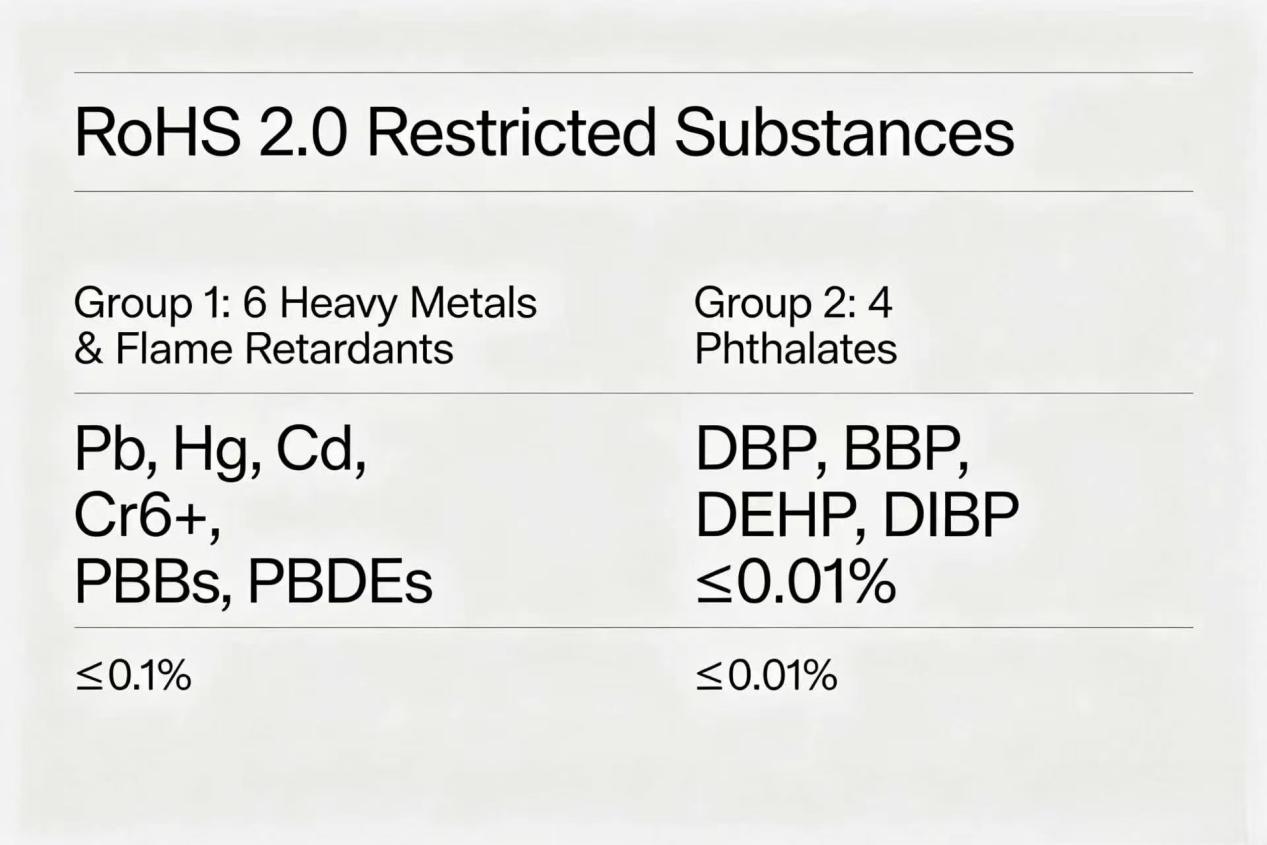
Split into two groups;factories shall prioritize testing plastic parts, cables and electroplated metal components.
1. Lead (Pb): ≤0.1% | High risk in solders,metal plating and power terminals
2. Mercury (Hg): ≤0.1% | High risk in lighting fixtures,circuit boards and sensors
3. Cadmium (Cd): ≤0.01% | Strictest concentration limit;frequent non-compliance found in electroplated parts,plastic color masterbatches and battery accessories
4. Hexavalent Chromium (Cr⁶⁺): ≤0.1% | High risk in metal surface coatings and anti-rust plating
5. Polybrominated Biphenyls (PBBs): ≤0.1% | Flame-retardant plastic housings
6. Polybrominated Diphenyl Ethers (PBDEs): ≤0.1% | Plastic flame retardant materials
DBP,BBP,DEHP,DIBP — uniform limit ≤0.1% High-risk applications: rubber, soft plastic casings,data cables,sealing gaskets and printing inks.Phthalate excess is the top focus of EU customs random inspections in recent years.
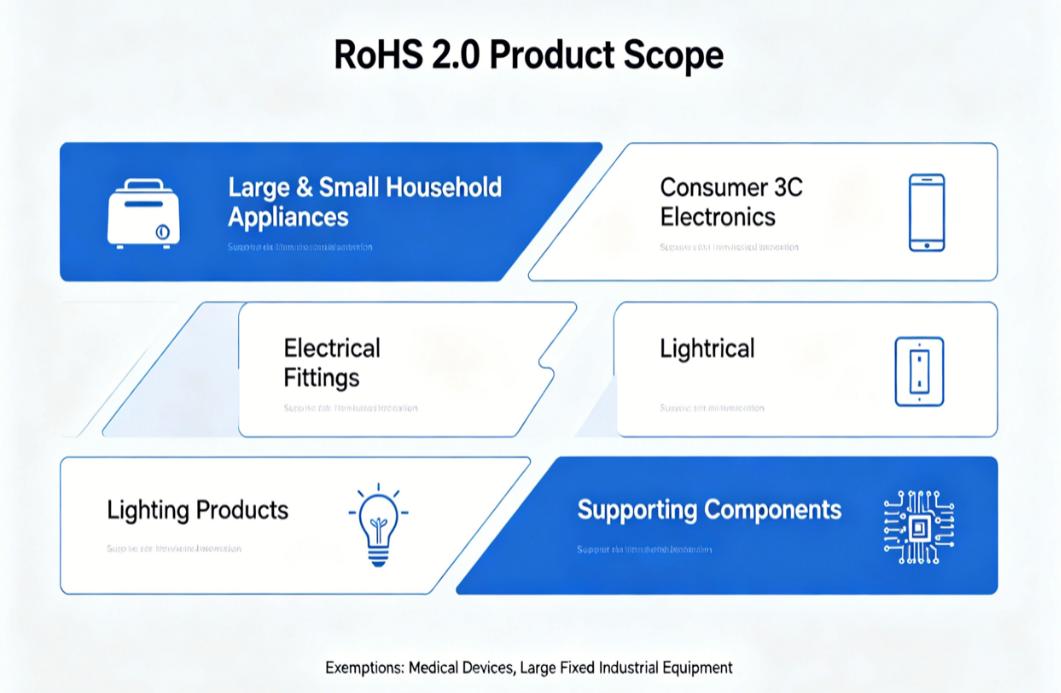
Nearly all finished electrical & electronic equipment and supporting components sold to the 27 EU Member States fall under this regulation:
Large & small household appliances: refrigerators, air conditioners, washing machines, hair dryers, small domestic appliances
Consumer 3C electronics: mobile phones, laptops, chargers, data cables, headsets, power banks
Electrical fittings: switches, connectors, wiring harnesses,power supplies, PCBs
Lighting products:LED lamps,fluorescent tubes,LED drivers
Supporting components: plastic housings, metal terminals, batteries, wires, hardware accessories
Exemption Note: Special categories such as medical devices and large fixed industrial equipment qualify for official exemptions under specific conditions.Enterprises must verify eligibility via the EU exemption database instead of assuming automatic exemption compliance.
RoHS 2.0 forms a core module of CE marking compliance.Products exported to the EU must bear the CE mark;full CE conformity cannot be achieved without valid RoHS compliance.
Documents to be retained include third-party RoHS test reports,material certificates,risk assessments and Declaration of Conformity (DoC). Incomplete documentation during EU market surveillance or customer factory audits will result in a non-compliance ruling.
Implement full-chain material control covering raw materials,spare parts and finished goods.Obtain valid RoHS compliance reports from all suppliers — verbal supplier guarantees are not acceptable evidence.
Consequences include customs detention,full container destruction or return shipments,heavy EU fines (up to 5% of total annual turnover), delisting from e-commerce platforms, order cancellation by major clients and permanent brand reputation damage.
Electrical & electronic exporters to the EU must satisfy both regulations simultaneously.
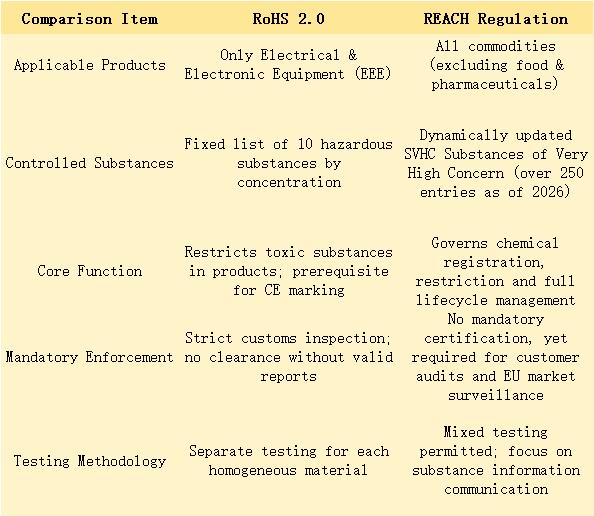
Quick Distinction for Exporters:RoHS controls heavy metals and plasticizers within electronic goods,while REACH governs all chemical substances contained in products.Both compliance sets are indispensable for EU market access.
HUAK Testing(https://www.huak-cer.com/) covers an area of over 4,000 square meters, including EMC, RF, 5G NR/6G (RF), Safety, Physical, Battery, and Chemical testing laboratories. It supports a wide range of products—from consumer goods like mobile phones, computers, toys, apparel, footwear, and cosmetics, to industrial control equipment and smart home devices—helping clients meet global market access requirements. The company is equipped with internationally advanced professional testing equipment and has assembled an elite team of senior industry experts and technical professionals. Team members, with their solid professional knowledge and rich practical experience, are able to accurately interpret various complex standards and technical requirements. As a well-known third-party testing laboratory in China, HUAK has been recognized by many international organizations, including the China National Accreditation Service(CNAS) for Conformity Assessment and the US A2LA. HUAK Testing is also the designated testing and certification service provider for Amazon, and maintains close cooperation with internationally renowned notified bodies such as MICOM, element, MET, and Germany's PHOENIXTESTLAB GmbH.


 English
 日本語
日本語 français
 Deutsch
 Español
 italiano
 русский
 português
 العربية
 Türkçe
 dansk
dansk