Many sellers fall into pitfalls when entering the Japanese market. Some products with Bluetooth/Wi-Fi get detained by customs even though only PSE is obtained. Others complete TELEC certification but are asked for additional electrical-safety certification by online marketplaces. What exactly are PSE and TELEC? Are they interchangeable? Which products require both certificates?
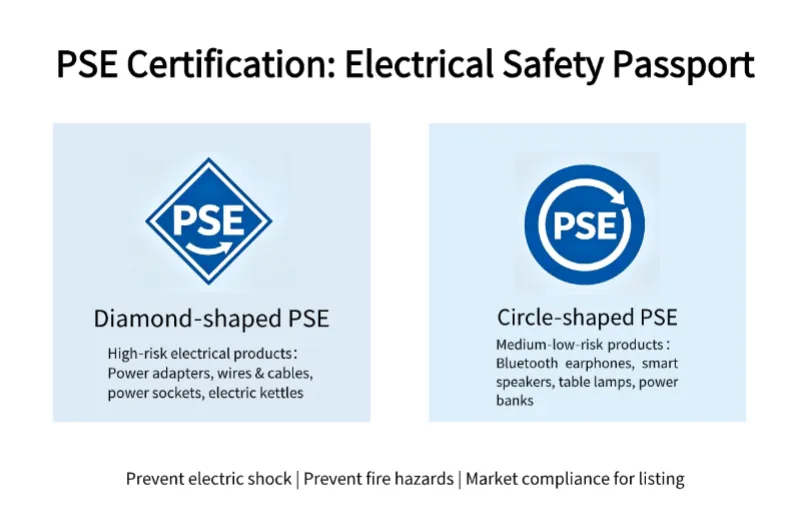
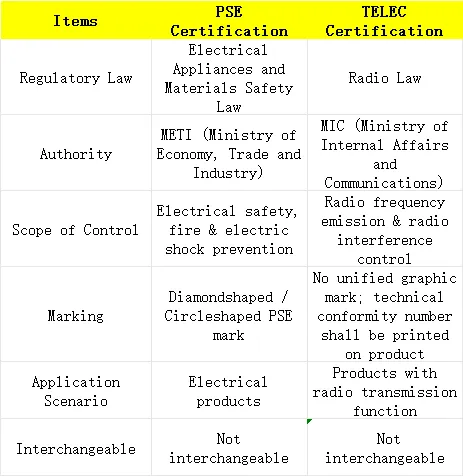
Full Name: Product Safety of Electrical Appliance & Materials Legal Basis: Japan Electrical Appliances and Materials Safety Law (DENAN) Authority: Ministry of Economy, Trade and Industry (METI) Core Purpose: Control electrical safety to prevent electric shock and fire hazards.
PSE includes Diamond-marked PSE (Class A: Specified Electrical Products) and Circle-marked PSE (Class B: Non-specified Electrical Products)
Diamond-marked PSE|High-risk Products: Mandatory third-party certification plus factory audit, mainly for high-risk appliances directly connected to mains power. Common items: power adapters, chargers, cables & wires, power sockets, electric kettles, rice cookers, power tools, etc.
Circle-marked PSE|Medium-low-risk Products: Self-declaration permitted upon passing testing with a relatively straightforward procedure. Common items: Bluetooth earphones, smart speakers, table lamps, power banks, laptops, small electric lighting appliances, etc.
Important Note: For most products with PSE certificates, METI registration is additionally required. This is a mandatory requirement for listing on Amazon Japan and Rakuten.
Also known as MIC Technical Conformity Certification (Gijutsu Tekigo Shomei) Legal Basis: Japan Radio Law Authority: Ministry of Internal Affairs and Communications (MIC) Core Purpose: Regulate radio frequency emissions and avoid interference with Japan’s public telecommunication networks.
In principle, TELEC certification is compulsory if a product actively transmits radio waves.
Products requiring TELEC: Bluetooth/BLE devices, Wi-Fi routers, smart cameras, 4G/5G IoT terminals, LoRa devices, wireless remote controls, walkie-talkies, drone remote controllers, etc.
Products exempt from TELEC: Signal-receiving-only devices (e.g. standard GPS receivers, simple FM radios)
Misconception Alert: CE / FCC radio test reports do not waive TELEC requirements. Japan adopts independent frequency bands and RF limit standards; mutual recognition is not applicable.
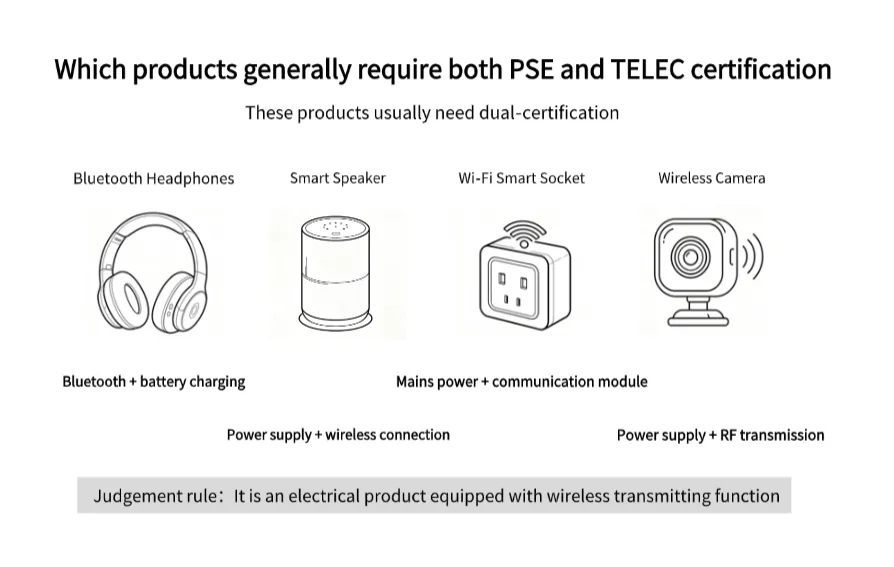
Two conditions must be met for dual certification requirement:
1. The product falls under PSE-regulated electrical-product scope
2. Built-in radio transmitters such as Bluetooth or Wi-Fi
Typical products: Bluetooth-enabled smart speakers, charging cases for Bluetooth earphones, Wi-Fi smart sockets, wireless cameras, 4G smart locks, IoT sensors, wireless-function robot vacuum cleaners.
Simple takeaway: PSE for electricity; TELEC for radio transmission. If both apply, get both certifications.
Q1: If the module has TELEC certification, the finished product does not need it.
In many cases, changes to the finished-product antenna structure invalidate module certificates. Full-product evaluation or re-testing may be required.
Q2: Certification obtained but METI registration skipped
Missing registration number will cause marketplace listing removal.
Q3: Mix-up between diamond-marked and circle-marked PSE, incorrect marking
Failed customs spot-checks and platform audits.
Q4: Low-energy Bluetooth does not require TELEC
Any RF transmission is governed by Radio Law; no exemption applies.
Q5: Continue using old certificates after hardware modification
Certificates become invalid once product structure, PCB or antenna is modified.
1. Confirm product classification: distinguish diamond / circle PSE; assess TELEC necessity
2. Prepare documents: product specification, circuit diagram, label drawing, test samples, Japanese-version user manual
3. Laboratory testing and rectify non-compliant items
4. Issue certificate, complete METI registration (for PSE) / obtain technical-conformity number (for TELEC)
5. Apply correct product marking for customs clearance and marketplace listing


 English
 日本語
日本語 français
 Deutsch
 Español
 italiano
 русский
 português
 العربية
 Türkçe
 dansk
dansk