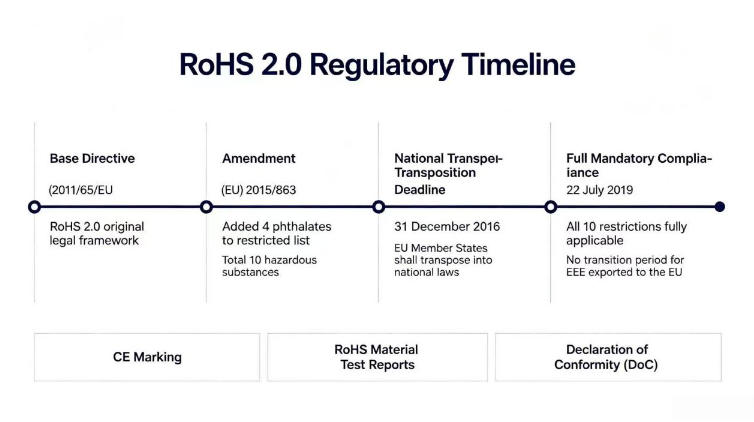
The foundational EU RoHS 2.0 directive is2011/65/EU,amended by the supplementary regulation (EU) 2015/863,which added four phthalate substances to the restricted list.
Key regulatory requirements:
All EU member states shall transpose this amendment into national laws and enforce implementation by December 31,2016.
Effective July 22,2019,the restrictions on all 10 hazardous substances are fully mandatory for all electrical and electronic products exported to the EU with no transition period.Finished products must comply with the CE conformity system,supported by RoHS material test reports and a formal Declaration of Conformity (DoC).https://www.huak-cer.com/certifications/rohs-testing-services/
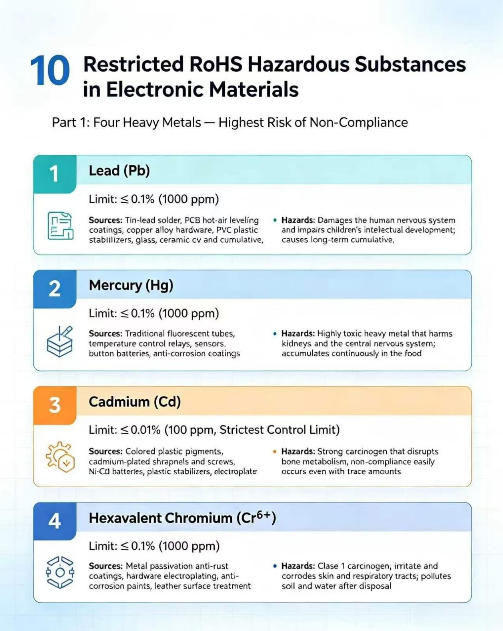
(1) Lead (Pb) ≤ 0.1% (1000ppm)
Common Material Sources:Tin-lead solder,PCB hot-air leveling coatings, copper alloy hardware,PVC plastic stabilizers,glass,ceramic capacitors, metallic inks.
Hazards:Damages the human nervous system and impairs children’s intellectual development;causes long-term cumulative pollution in soil and water bodies.
(2) Mercury (Hg) ≤ 0.1% (1000ppm)
Common Material Sources:Traditional fluorescent tubes,temperature control relays,sensors,button batteries,anti-corrosion coatings.
Hazards:Highly toxic heavy metal that harms kidneys and the central nervous system;accumulates continuously in the food chain.
(3) Cadmium (Cd) ≤ 0.01% (100ppm,Strictest Control Limit)
Common Material Sources:Colored plastic pigments,cadmium-plated shrapnels/screws,Ni-Cd batteries,plastic stabilizers,electroplated surface coatings.
Hazards: Strong carcinogen that disrupts bone metabolism; non-compliance easily occurs even with trace amounts.
(4) Hexavalent Chromium (Cr⁶⁺) ≤ 0.1% (1000ppm)
Common Material Sources: Metal passivation anti-rust coatings,hardware electroplating,anti-corrosion paints,leather surface treatment agents.
Hazards: Class 1 carcinogen;irritates and corrodes skin and respiratory tracts;pollutes soil and water after disposal.
(1) Polybrominated Biphenyls (PBB) ≤ 0.1% (1000ppm)
(2) Polybrominated Diphenyl Ethers (PBDE) ≤ 0.1% (1000ppm)
Common Material Sources:ABS/PC plastic housings, flame-retardant plastics,power supply casings,wire insulation layers.
Hazards:Disrupts human endocrine and thyroid functions; non-biodegradable with long-term environmental persistence.
DEHP, BBP, DBP, DIBP – Uniform limit:≤0.1%(1000ppm)
Common Material Sources: PVC cables,silicone soft rubber,sealing gaskets, artificial leather,printing inks,adhesives,plastic sheaths.
Hazards:Reproductive toxicity and developmental interference in children; classified as endocrine disruptors.
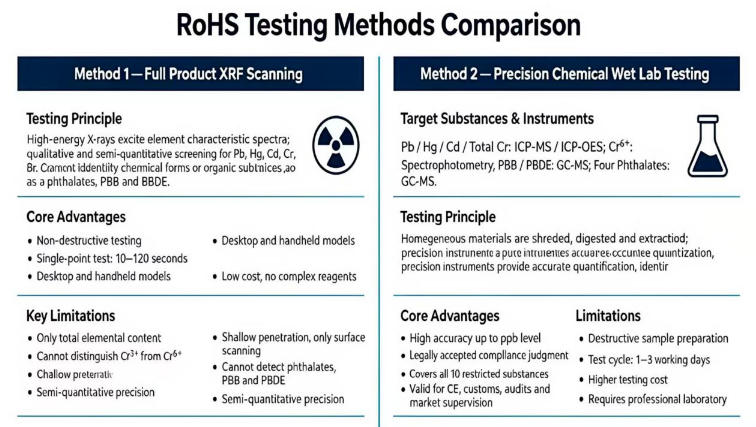
High-energy X-rays irradiate test samples to excite characteristic fluorescent spectra of internal elements.The system conducts qualitative and semi-quantitative screening of metallic elements (Pb, Hg, Cd, Cr, Br) via spectral energy analysis.It only supports elemental screening and cannot identify chemical forms or detect organic substances such as phthalates,PBB and PBDE.
Non-destructive testing:No disassembly or damage to finished products, semi-finished products or raw materials;
Ultra-fast detection:Single-point testing takes only 10–120 seconds, suitable for mass incoming material inspection,production line patrol testing and finished product spot checks;
Flexible & portable:Available in desktop and handheld models for on-site testing in workshops and warehouses;
Low cost:Low expense for single screening,no complex chemical reagents or pre-treatment required.
Only detects total elemental content without distinguishing chemical forms:e.g.,detected chromium cannot be differentiated between compliant trivalent chromium and prohibited hexavalent chromium;detected bromine cannot be distinguished between restricted PBB/PBDE and compliant bromide compounds.
Shallow penetration depth (only tens of microns):Only scans sample surfaces,failing to detect hazardous substances in inner interlayers or coating bottom layers.
Incapable of organic substance detection:The four phthalates,PBB and PBDE can only be verified via chemical testing.
Semi-quantitative precision:Prone to numerical deviation for cadmium and trace heavy metals;chemical re-testing is mandatory for suspected non-compliant screening results.
Incoming material preliminary screening,in-production patrol inspection, rapid finished product verification,warehouse raw material sampling. Only for preliminary screening; not accepted as final compliance reports for EU customs clearance or CE certification.
Heavy Metals (Pb/Hg/Cd/Total Cr):ICP-MS / ICP-OES wet digestion testing
Hexavalent Chromium (Cr⁶⁺):Spectrophotometry (IC)
Brominated Flame Retardants(PBB, PBDE):GC-MS(Gas Chromatography-Mass Spectrometry)
Four Phthalates(DEHP/BBP/DBP/DIBP):GC-MS(Gas Chromatography-Mass Spectrometry)
Homogeneous materials are shredded and digested via strong acid and organic solvent extraction to separate target hazardous substances. Precision instruments deliver accurate quantitative detection,enabling precise identification of substance types,exact content values and differentiation of elemental chemical forms and organic compounds.
Extremely high quantitative accuracy with detection limit up to ppb level; legally recognized judgment method for RoHS compliance.
Able to distinguish chemical forms:accurately differentiates hexavalent/trivalent chromium and prohibited PBB/PBDE from compliant bromides.
Fully covers all 10 restricted substances;the only valid method for detecting phthalates and brominated flame retardants.
Issuable chemical test reports are valid for CE certification,EU customs clearance,factory audits and market supervision inspections.
Destructive testing:Samples are shredded and digested (non-reusable); finished products require disassembly to extract homogeneous test materials.
Complicated procedures: Complete process including sample pre-treatment, digestion and instrument testing takes 1–3 working days.
High testing cost:Single-material testing fees are significantly higher than XRF scanning.
No on-site rapid detection:Tests must be conducted by professional third-party laboratories.
EU export CE certification,customs re-inspection,official customer audits,final confirmation of XRF suspected non-compliance,and long-term raw material compliance filing.
1. Conduct batch rapid XRF full-scanning for incoming materials and finished products;release qualified products with no non-compliance risks.
2. For samples with XRF values close to limit standards or suspected non-compliance,disassemble homogeneous materials and send to laboratories for precision chemical testing.Chemical test results serve as the final compliance judgment basis.
3. Chemical test reports are mandatory for EU product filing and customs clearance;pure XRF scanning reports are not recognized by EU regulatory authorities.
HUAK Testing Certification Service Advantages
HUAK Testing(https://www.huak-cer.com/ covers an area of over 4,000 square meters, including EMC, RF, 5G NR/6G (RF), Safety, Physical, Battery, and Chemical testing laboratories. It supports a wide range of products—from consumer goods like mobile phones, computers, toys, apparel, footwear, and cosmetics, to industrial control equipment and smart home devices—helping clients meet global market access requirements. The company is equipped with internationally advanced professional testing equipment and has assembled an elite team of senior industry experts and technical professionals. Team members, with their solid professional knowledge and rich practical experience, are able to accurately interpret various complex standards and technical requirements. As a well-known third-party testing laboratory in China, HUAK has been recognized by many international organizations, including the China National Accreditation Service(CNAS) for Conformity Assessment and the US A2LA. HUAK Testing is also the designated testing and certification service provider for Amazon, and maintains close cooperation with internationally renowned notified bodies such as MICOM, element, MET, and Germany's PHOENIXTESTLAB GmbH.
NEXT


 English
 日本語
日本語 français
 Deutsch
 Español
 italiano
 русский
 português
 العربية
 Türkçe
 dansk
dansk