A new chemical regulation has officially taken effect,directly affecting product compliance and market access in the EU.
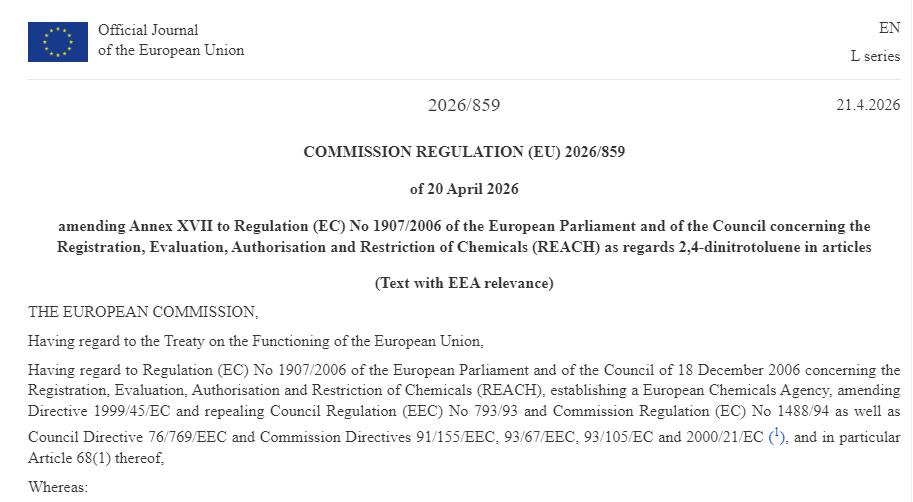
On 20 April 2026,the European Union published Regulation (EU) 2026/859 in the Official Journal,amending REACH Regulation (EC) No 1907/2006.A new Entry 83 regarding 2,4-dinitrotoluene has been added to Annex XVII.As a qualified third-party testing laboratory,we have summarized the core requirements of this new regulation to help you understand the restrictions clearly and avoid compliance risks.
This new entry aims to restrict the placing on the market and use of articles containing high levels of 2,4-dinitrotoluene,focusing on products accessible to professional users and the general public.
Key Basic Information
Substance: 2,4-Dinitrotoluene (2,4-DNT)
CAS No.: 121-14-2
EC No.: 204-450-0
Effective Date:The regulation enters into force on the 20th day after publication in the EU Official Journal,namely 10 May 2026.
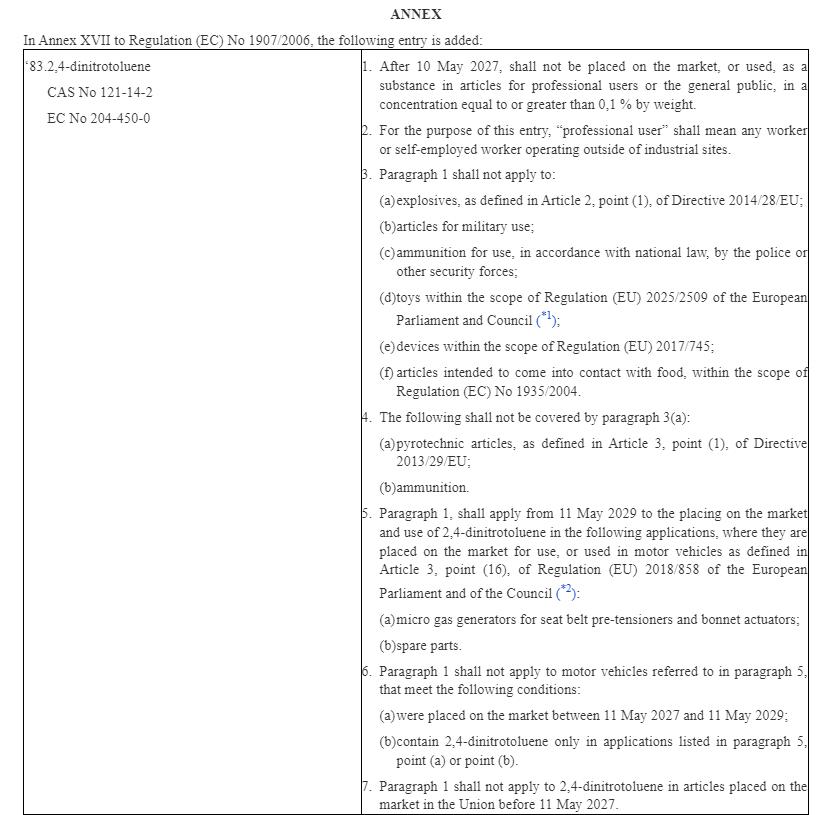
1. From 10 May 2027, articles intended for professional users or the general public shall not be placed on the market or used if they contain 2,4-dinitrotoluene at a concentration ≥ 0.1% by weight.
2. Definition of Professional User: Any worker or self-employed person operating outside industrial premises.
3. Six Exemption Categories:(a) Explosives as defined in Article 2(1) of Directive 2014/28/EU;(b) Military articles;(c) Ammunition used by police or security forces in compliance with national legislation;(d) Toys within the scope of Regulation (EU) 2025/2509;(e) Devices covered by Regulation (EU) 2017/745;(f) Food contact materials and articles under Regulation (EC) No 1935/2004.
4. Supplementary Note: The exemption for explosives does not apply to pyrotechnic articles (defined in Directive 2013/29/EU) and conventional ammunition.
5. Extended Restriction for Automotive Products:The restrictions shall apply from 11 May 2029 to mini gas generators for seat belt pretensioners,hood actuators and related spare parts in motor vehicles.Motor vehicles placed on the market between 11 May 2027 and 11 May 2029, only containing this substance for the above applications, are exempted.
6. Stock Exemption: Articles containing 2,4-dinitrotoluene already placed on the EU market before 11 May 2027 are not subject to these restrictions.
2,4-Dinitrotoluene (2,4-DNT) is classified as a Category 1B Carcinogen under Regulation (EC) 1272/2008 and is listed as an SVHC (Substance of Very High Concern) in REACH https://www.huak-cer.com/certifications/reach-compliance-certificate/,meeting the high-hazard criteria of REACH Article 57(a).
It is a non-threshold carcinogen with no identifiable safe exposure level (DNEL).Long-term exposure may cause irreversible damage to human health.
EU investigations confirm that 2,4-DNT is widely found in electronics, ceramics,motor vehicles(seat belt pretensioners,airbags),plastic containers,ammunition and other daily products.Due to its chemical properties,it tends to migrate in plastic materials,leading to potential risks via skin contact and inhalation—especially for the general public and non-industrial professional users.
Many suppliers confuse Annex XVII restrictions with SVHC obligations.The key distinctions are clarified below:
Scope of Control SVHC rules apply to all goods manufactured in or exported to the EU.Annex XVII sets clear, product-specific restrictions for each entry (this new rule mainly covers articles for public and non-industrial professional use).
Compliance Obligations Products exceeding SVHC threshold limits can still enter the EU by fulfilling notification and supply chain information duties.Substances restricted under Annex XVII must fully comply with concentration limits.Non-compliant products are strictly prohibited from being sold in the EU.
As a professional third-party testing and certification provider,we offer practical suggestions for EU exporters:
Conduct full supply chain screening:Review raw materials of plastics,auto parts, electronic products,ceramics and other high-risk items to verify the presence and concentration of 2,4-DNT.
Arrange professional testing:Entrust an accredited laboratory to complete 2,4-DNT testing for high-risk products and retain valid test reports as official compliance documentation.
Arrange production adjustments in advance:With phased transition deadlines (May 2027 / May 2029), optimize production processes and replace restricted raw materials gradually to ensure stable EU exports.

EU chemical regulations continue to tighten,and updates to REACH Annex XVII have become routine.The new restriction on 2,4-DNT further demonstrates the EU's strict supervision over carcinogenic substances.We provide one-stop testing, compliance consulting and regulatory update services to help your products meet the latest EU standards and eliminate export risks.
HUAK Testing(https://www.huak-cer.com/ covers an area of over 4,000 square meters, including EMC, RF, 5G NR/6G (RF), Safety, Physical, Battery, and Chemical testing laboratories. It supports a wide range of products—from consumer goods like mobile phones, computers, toys, apparel, footwear, and cosmetics, to industrial control equipment and smart home devices—helping clients meet global market access requirements. The company is equipped with internationally advanced professional testing equipment and has assembled an elite team of senior industry experts and technical professionals. Team members, with their solid professional knowledge and rich practical experience, are able to accurately interpret various complex standards and technical requirements. As a well-known third-party testing laboratory in China, HUAK has been recognized by many international organizations, including the China National Accreditation Service(CNAS) for Conformity Assessment and the US A2LA. HUAK Testing is also the designated testing and certification service provider for Amazon, and maintains close cooperation with internationally renowned notified bodies such as MICOM, element, MET, and Germany's PHOENIXTESTLAB GmbH.


 English
 日本語
日本語 français
 Deutsch
 Español
 italiano
 русский
 português
 العربية
 Türkçe
 dansk
dansk